Pages

Saturday, April 28, 2018

EDINBURGH | Visit to The Lord Lyon

Coat of Arms of The Lord Lyon King of
Arms of Scotland.
Oxford, April 29, 2018–I was in Edinburgh earlier this week and visited the offices of The Lord Lyon King of Arms of Scotland.

The office is centrally located in Edinburgh, on West Register Street. 

Unlike most other countries where the heraldry authorities are private or nonprofit and honorific, the Scottish heraldry office was made part of the government. The heraldry code has the force of law in Scotland, and The Lord Lyon can prosecute, which is rare or unique in the world (South Africa can prevent use of a coat of arms).
Approach to the National Records of Scotland,
on West Register Street. There is construction.

The portrait in the lobby of The Lord Lyon is that of past Lord Lyon Sir Malcolm Rognvald Innes of Edingight KCVO WS FSA Scot. He held the post for 20 years, 1981-2001. The current Lord Lyon is the third since 2001.

He was born on May 25 in a year ending in 8. His portrait shows him in the tabard of The Lord Lyon. He is now Orkney Herald Extraordinary.

I had contacted The Lord Lyon's office to ask about the possibility that the stars in the Stars and Stripes were inspired, directly or indirectly, by the mullets in the Douglas or Murray (Moray) coats of arms.

Elizabeth Roads, Snawdoun Herald and Lyon Clerk at the Court of the Lord Lyon kindly responded to my query, wondering how I would associate with Scotland the Washington family, which prior to the emigration of two sons of Lawrence Washington lived in Sulgrave Manor, Northampton, way down south, not far from Oxford.
The National Records of Scotland.

I responded that the family originally lived in Washington on the River Wear, then part of the Palatine Principality and See of Durham, near Scotland. 

Before George Washington's ancestors were called Washington, they were Wessyngton, and before that Hertburn, after the places they resided, near what became the city of Newcastle. 

George Washington's Ancestors

The Ur-Washington was Sir William fitz Patrick de Hertburn, eldest son of Sir Patrick fitz Dolfin Raby and grandson of Dolfin fitz Uchtred. 

Sir Patrick fitz Dolfin Raby was born before 1136 at Hertburn, a younger son of Dolfin fitz Uchtred. Upon his marriage to Cecily de Offerton, he became known as Sir Patrick de Offerton and Le Hirsel. The Le Hirsel land lies on the north bank of the River Tweed two miles NW of Coldstream. He died c. 1190.

Sir William fitz Patrick de Hertburn was born c. 1150 in Hertburn, near Stockton-on-Tees (about halfway between Newcastle and York). He married twice, gaining Stockton lands with his first marriage and gaining royal relatives with his second marriage to Marjory (Margaret) de Huntingdon, Countess of Richmond. Sir William and Countess Margaret were close in age, although this was her third marriage.

Margaret's brothers were William the Lion, King of Scotland, and Malcolm IV, the Maiden King of Scotland. Her father was Henry, Earl of Northumberland and Huntingdon, and her paternal grandfather was David I, King of Scotland and saint. Her youngest brother, David Earl of Huntingdon, was ancestor of the de Bruce and Balliol families. Countess Margaret's four times great-grandparents were Beatrix, Queen of Scotland and Crinan the Thane. 


So Hertburn acquired new lands and noble connections  with his new bride. He assumed tenancy of the Wessyngton  lands from the Prince Bishop of Durham at a cost of four pounds per year. He had received the Wessyngton property in trade for his Stockton lands – a good move, since he was already heir to the lands at Offerton, just across the River Wear from Washington. Given his huge step up in status, Hertburn took on the name William de Wessyngton in 1183. He died c. 1190.

Sources for the above include: 1. Audrey Fletcher, Posting as Washington Lass 
2. Archaeology Data Service, UK, 1960 


Comments:

  • Today The Hirsel is the seat of the Earls of Home, and the 14th Earl, Sir Alec Douglas-Home, was British Prime Minister in 1963-1964 when I was a student at Oxford – he contributed an article to a magazine I edited, Oxford Tory. I served as General Agent of the Oxford University Conservative Association when Lord James Douglas-Hamilton, now Baron Selkirk of Douglas, was President.
  • George Washington's hero was General William Braddock of the Coldstream Guards. Together they attacked Fort Duquesne, which was renamed Pittsburgh, after Pitt the Elder, who was the patron of the war against the French in North America. Braddock gave Col. Washington his sash and Washington is shown wearing it in several portraits.
Visit to the office of The Lord Lyon in Edinburgh. L to R: (1) Snawdoun Herald and Lyon Clerk, Elizabeth Roads. (2) Portrait of Immediate past Lord Lyon, Sir Malcolm Rognvald Innes of Edingight KCVO WS FSA Scot, with a magnificent estoile above. (3) Your blogger with what seems to be a tiny coronet in chief.

Visit to The Lord Lyon

Snawdoun Herald again was kind enough to respond and wondered why a family so well-connected by marriage would wish to connect to the humbler (at the time) Douglas arms.

My answer is that the Washington coat of arms was not created until after the Battle of Crécy, by which time the Douglas family was ennobled and well established.

At this point there are so many clues and question marks that I am pausing in my quest. A good time to visit Snawdoun Herald and the office of The Lord Lyon!


Also see: My Visit to the College of Arms in London

CLUBLAND | Some Good Ideas

I have been staying at some Reciprocal Clubs in Scotland and England, and a couple of ideas make a lot of sense to me:


1. Open. Insert chain goes through the sleeve
of a coat and the loop on an umbrella. Put the
bottom of the chain through the locking hole.
REPLACE A CLOAKROOM ATTENDANT.  Instead, use chains and keys. Some clubs in New York have two cloakrooms or add a cloakroom for special events. Surely one cloakroom could be self-service, for people who are not worried sick that someone will steal their coat (has never happened to me in 50 years of using a New York club). 

Every club of course needs a concierge for people with valuables like a computer in their bag, or a suitcase. One club in New York seems to be  totally trusting about books and book bags. 
2. Lock, after first putting a £1 coin in a 
slot (it can be recovered when the coat is 
picked up).

Here's what a London club does. It has a long wall of coat hooks, and you protect your coat from theft or careless coat pickup by locking the coat to the hook with a chain.

With modern computer advances, there must be a more efficient way of doing this that does not require a coin.

Maybe a credit card could be used to close and then reopen the lock. It would also provide evidence if the club had problems with their system or there was a dispute about ownership of the coat.

3. Take away the plastic key, which
opens the lock on your return.
IPHONE RECHARGING. Another innovation I saw at a London club was the use of an iPhone recharging station. 

It looks like a set of post office boxes but inside each one is a plug to recharge an iPhone. This is valuable for people who can leave their iPhone while they have a meal or a drink, and pick it up recharged on their way out.


Thursday, March 22, 2018

CHARLIE MINER, R.I.P. | Vero Beach and East Hampton

Charlie Miner (R) enjoying his great-nephew and great-great-
niece and her (unrelated) Angry Bird. (Photo by JT Marlin.) 
March 20, 2018 – Charlie Miner interrupted his studies at Princeton (Class of 1943) to sign up with the U.S. Army Air Forces.

He served in Europe as pilot of a B-25 bomber.

He died yesterday, according to his daughter, and Vero Beach resident, Charmaine Caldwell.

A memorial service in Vero Beach is planned for May 3 and another one in the summer in East Hampton. 

The following is a slightly edited version of an article I wrote about Miner for The Vero Portfolio, May-June 2015 issue, p. 24. The ending is, of course, updated.

Charlie Miner was one of seven grandchildren of his illustrious grandfather, FDR’s first Treasury Secretary, Will Woodin. His mother was Woodin's eldest daughter, Mary, who married an infantry captain, Robert Charles (Charlie) Miner, Sr., grandson of famed anti-slavery Federalist Congressman Charles Miner. 

Miner divided his time at the end of his life between Vero Beach and East Hampton until his cousin and constant companion Anne Gerli died in 2016. 

He was born in New York City in 1921 and prepared for college at Buckley School and Choate. At Princeton he studied engineering and joined the war effort as pilot of a B-25 Mitchell twin-engine bomber, which had a crew of three or more. Miner flew many of the 18 bombing missions of his squadron over northern Italy. [More about his contribution to the war effort here.]

He was lucky to have survived. Of 16 million American veterans of World War II, fewer than one in 16 were alive in 2015, only 80,000 in Florida. That year Miner was one of only about 250 World War II vets left in Indian River County, when he may have been Indian River County's oldest surviving European-theater WWII bomber pilot.

Miner told me how much he loves Vero Beach. Years ago in the 1950s and 1960s, he spent time with his mother (who divorced Charlie Sr. and did not remarry) in the Riomar social life. It  revolved, he said, around rotating dinners and celebrations among the original 12 houses. The 30 residents took turns throwing parties. The Riomar clubhouse facilities came later. John's Island—where Miner and his late wife Maisie lived—opened in 1970 and he said was at first resented because it drew people away from Riomar (and then became successful, and was imitated by the Moorings).

Charlie Miner’s grandfather, Will Woodin, was the man who dealt with the Wall Street and banking panic that started in 1929 and was not put to rest until FDR came into office in March 1933. FDR's first Treasury Secretary was given wide latitude in addressing the problem. 


Will Woodin was born in Pennsylvania and settled in New York after a successful career as the CEO of a huge business selling railroad rolling stock. He had four children. The eldest and youngest settled in Vero Beach — Mary Woodin Miner and Libby Woodin Rowe. Libby’s husband, Wally Rowe, and a brother bought homes in Riomar. Mary and Libby eventually lived in Vero Beach most of the year. Charlie’s mother lived in John's Island after Riomar and died in 2007 at 102.

Charlie remembers not just the bridge that connected the two sides of the Indian River, "Beachland Boulevard" where Route 60 crosses, before the concrete-arch Barber Bridge.  He remembers the drawbridge that was built earlier, in 1995. Before that, back in the 1930s, there was a bridge made of wooden railroad ties and swung around horizontally to let boats through the Indian River. 
Charlie (R) and me in 2014. Photo by
Alice Tepper Marlin.

Back in those early days Beachland Boulevard was the northern edge of Vero Beach, and there wasn’t a Riverside Theater. Charlie says the money was raised in several ways. Rosie and Sterling Adams organized a dance every year. He and his cousin, Bill Rowe, used to sell season tickets and organized an auction of donated prizes to raise money for the theater. The Theater is, of course, now a central  institution in Vero, contiguous to the Vero Museum of Art.

What Charlie Miner liked about Vero is that it is quiet. That was one of the original motivations of the developers, along with the availability of rail transportation and ocean beaches. There is no strip with night clubs, no airport. As Charlie says, “I’m not a teenager anymore.”

Charlie’s Advice at 93 for a Long and Happy Life:


  • For a Long Life: Every morning a meal of two eggs and tomato juice or V-8 (with or without the hair of the dog). 


  • For a Happy Life: “Enjoy life while you can. If you want to do something, don’t wait. Do it while you can because life goes by quickly. You may never get another chance.” He says his years have “Gone… Boom!”

  • During the many recent years that I have been studying and writing about FDR's forgotten first Treasury Secretary, Charlie's grandfather, I and my wife Alice have been amused and impressed by Charlie's joie-de-vivre and his sharp recollections of his long life. It was a sad moment when I learned of his death, just two months after he celebrated his 96th birthday.

    Postscript, May 3, 2018: The East Hampton Star just published my "Guest Words" on the passing of Charlie Miner, remembering him and others who have bravely faced the guns of Adolf Hitler.

    Thursday, February 15, 2018

    HAPPY YEAR OF THE DOG | Good Luck Year, But Not for Trump

    Happy Chinese New Year!
    It will be the Year of the Dog in the zodiac calendar. It is the Year of the Earth Dog. (The twelve years of the zodiac cycle within a larger 48-year cycle governed by the four ancient elements, fire, water, earth, air, similar to the length of the Kondratiev cycle.)
    This can be a lucky year, because the dog is loyal. But it is an unlucky year for those born in a prior Year of the Dog.
    Donald Trump was born in such a prior year, 1946 (he, Bill Clinton and George W. Bush were born within three months of each other).

    Those who take the feng shui of the zodiac calendar seriously are predicting that Trump will have bad luck in this year, from February 16, 2018 through the beginning of the next year in February 2019, which will start the year of the pig.

    Wednesday, February 14, 2018

    BIRTHDAYS | March 2018 (Children's Book Authors)

    Women's History Books for Kids

    2 - Dr. Seuss, 1896-1991
    3 - Erik Blegvad, 1923-2014 - Patricia MacLachlan, 1938
    4 - David A. Carter, 1957 - Peggy Rathman, 1953
    5 - Mem Fox, 1946 - Howard Pyle, 1853
    6 - Sid Fleischman, 1920 - Chris Raschka, 1959
    8 - Peter Roop, 1951 - Robert Sabuda, 1965 - Kenneth Grahame, 1859 - International Women's Day
    9 - Margot Apple, 1946
    11 - Peter Sis, 1949
    12 - Marguerite De Angeli, 1889 - Virginia Hamilton, 1934 - Carl Hiaasen, 1953
    13 - Diane Dillon, 1933 - Death of Claire Huchet Bishop, 1993 (b. 1899, date unknown).
    St Patrick's Day is March 17
    15 - Ruth White, 1942 - Heidi Whitaker
    17 - Penelope Lively, 1933 - Patrick McDonnell, 1956 - Wendell Minor, 1944 – St Patrick's Day (during the month before this date, a special discount is offered to previous Boissevain Books customers; you should have received an email about this on Feb. 17 or 18)
    18 - Douglas Florian, 1950
    20 - Mitsumasa Anno, 1926 - Lois Lowry, 1937 - Bill Martin Jr., 1916 - Louis Sachar, 1954
    21 - David Wisniewski, 1953
    22 - Randolph Caldecott, 1846
    26 - Betty McDonald, 1908
    27 - Dick King-Smith, 1922 - Patricia C. Wrede, 1953
    30 - Anna Sewell, 1820

    Boissevain Books LLC is a publishing company created by the six children of Hilda van Stockum – five of them (Olga, Brigid, Randal, John and Elisabeth) alive at the end of December 2017, Sheila having sadly died on September 25, 2017 in Watford, UK. The primary mission of Boissevain Books is to keep Hilda van Stockum's 25 award-winning books for children available for purchase and remembered after her death in 2006.
    ----- 

    Other Months of Birthdays of Writers4Kids: February 2018 . January 2018 . December 2017 .  November 2017.  October 2017 .  September 2017 . August 2017 . July 2017 .  June 2017 . May 2017 . April 2017 . March 2017 . February 2017

    All original content in this post © 2006-2018 by Boissevain Books LLC.

    Tuesday, February 13, 2018

    BENEDICTINE REUNIONS | Vero Beach, Florida

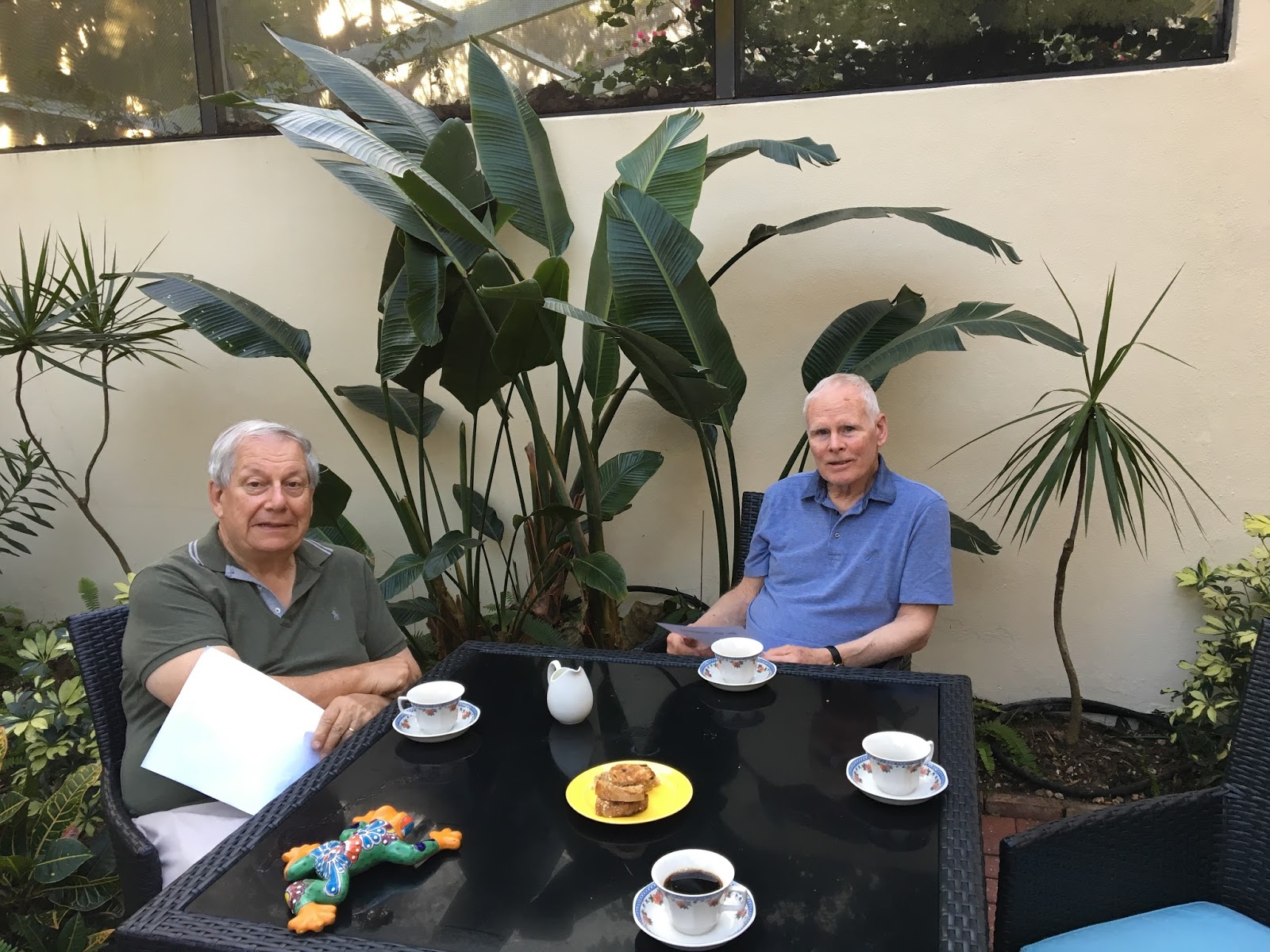
    Denis at our house in Vero. He calls this our national security
    strategy meeting. He was born in India. His father was a
    British Army Brigadier. Denis served in the U.S. Army.
    Products of the English Benedictine Congregation had several mini-reunions in Vero Beach, Florida this past week.

    First we had a formal lunch reunion, about 30 people, at the Moorings Club, south of Vero Beach, kindly sponsored by alumni members of the club. 

    Several representatives of Portsmouth Abbey School visited, including the incumbent headmaster, as part of an annual tour of retired Portsmouth alumni in Florida. The tour usually takes in Miami, Fort Lauderdale and Palm Beach as well as Vero Beach.  
    We were joined by the family dog, Hachikō.
    Denis holds on to a palm leaf to restrict its growth.

    I attended the event in 2015 and again last year when relatives of the late Fr. Damian Kearney were there who reside in the Vero Beach area.  

    A few days later, I had a visit from Robert Denis Ambrose, who was known as Bob at Portsmouth and as Denis at home and currently. 

    Denis was at Portsmouth for the two academic years 1953-1955, first in the Barn, headed then by Fr Bede, and then at St Bede's House, where the housemaster was Fr Hilary. Denis says he has fond memories of these years. He remembers also Fr Aelred ("Barney") Wall and the Associate Headmaster, Cecil Acheson, from Ampleforth.
    We looked over the potential attendance list for the Portsmouth
    Class of 1958 60th Reunion, planned for Newport, Sept. 28.

    Denis then transferred to Ampleforth College, at St Wilfred's House. He told me it was a bit of a shock to go from the more laid-back environment of Portsmouth to Ampleforth. 

    Denis recalls many moments of his time at Ampleforth, and personalities such as Regimental Sergeant Major Hennessy, Father Julian, the swimming coach and the teas after swimming meets, especially the away matches where the teas were a schoolboy's dream. 

    Denis was taken aback by the number of rules at Ampleforth, many more than at Portsmouth, and the fact that they were effectively enforced. Boys were not allowed to eat candy bars on public streets, for example, and were forbidden to sit on radiators.

    He has strong memories of his study of history at Ampleforth. He says that one theme that recurred was: "England's foreign policy is and has been about maintaining the 'balance of power'." 

    (My own recollection is studying the Wars of the Roses to death. I learned that a red rose of Lancaster does not smell as sweet as a white one of Yorkshire.)

    England may no longer rule the waves, but that doesn't mean it will now Waive the Rules. The central heating in British schools and universities, he thinks, is still not turned on till late November. He likes a book by Jeremy Paxman, The English. 

    Despite the rigors of the English classroom and plumbing, Denis believes, both Ampleforth and Portsmouth hold out a model of peace and tolerance, the Benedictine way of life, that is a worthy one to follow.
    L to R: Denis, John, Bill.
    After three years serving in the US Army, Denis trained as a civil engineer, spending several years designing bridges and obtaining a Professional Engineering License. 

    Subsequently he obtained a bachelors degree in business from the University of Pittsburgh and an MBA from Lebanon Valley College. He was engaged in economic feasibility studies and valuation studies for water and wastewater projects including certifications for bond issues and rate covenants and presentation of testimony before regulatory agencies.  He still provides consulting services on a limited basis. 

    The same summer of 1955 in which Denis was heading across the Atlantic from Portsmouth to Ampleforth, I was going the other way. 

    I found the transition relatively painless. I had been at Gilling Castle and the Junior House at Ampleforth College for three years.
    The academic environment at Ampleforth was austere, Old School... My brother was in the upper school and used to visit me with the late Johnny Encombe, who also had a younger brother at Gilling.


    L to R: John (pushing back on a fast-growing Bougainvillea), Bill and Denis.
    I started learning Greek at Gilling Castle as well as continuing Latin and French. Our ancient history teacher, Fr Bruno, gave us vivid descriptions, which have stayed with me more than 60 years, of the Battles of Marathon, Salamis and Thermopylae.

    Denis stayed with us in Vero for a few days, during which time we paid a visit nearby to Bill (Gregory) Floyd, Portsmouth '57 and former Abbey headmaster. 

    Thursday, January 25, 2018

    WOODIN(G) | Did Will Woodin's British Ancestors Bear Arms?

    If you search online for the name Woodin or Wooding (which sometimes seem to have been used interchangeably in the 17th century in Britain and the United States), you will find Coats of Arms attributed to them. I found them and sought advice from William Hunt, former Windsor Herald of the College of Arms. I sent him three designs of Arms attributed to Woodin(g) in which the dominant charges are Pheons, Owls, and Roses. 

    All three employ chevrons, which suggests that this is the common theme among Woodin(g) arms. Connecting the chevron with the name Woodin makes sense, because the chevron is seen as a rafter. It would have been made of wood, and a rafter provided shelter as would a woodworker or forester.

    Pheons. A pheon is a barbed arrowhead, which can have its points up or down. The first looks as though it would be blazoned: "Sable a Chevron Argent between three Pheons Argent points upwards Sable" and the historical background below the Arms says it is in Burke's General Armory in 1884.

    Hunt, who after retirement in 2017 is now research assistant to John Petrie, Rouge Croix Poursuivant, looked for a record of grants of the claimed Arms and found none. His report to me on this design is that Arms looking like this were confirmed, but not to anyone named Woodin(g).
    [It] was confirmed to William Sulyard of Eye at the Visitation of Suffolk in 1561 (G7.24b). [Blazoned with a different tincture, "Argent a Chevron Gules..."]
    Hunt did a thorough search and found no arms for Woodin(g) except for a recent (1994) grant to a Wooding.
    I have checked our records and can report that there has been no confirmation or grant of Arms to someone of this name [before 1994]. I have checked the grants made in Scotland before 1972, and there is none there either. We have photographs of the Arms granted and pedigrees recorded in the Ulster Office, which was the heraldic authority under the British Crown 1552-1943. Despite what Burke’s General Armory says, there is no reference to this name there either. 
    Owls and Roses. In addition, I sent two designs featuring owls and roses. Both have been attributed to a Woodin(g). One was blazoned "Gules a Chevron between three Owls Argent" (below, left) and the other featured roses (below, right):


    The response on these two designs was equally negative:
    [The design] with the owls [was confirmed] to Sir Samuel Sleigh at the Visitation of Derbyshire in 1662 (C34.4b) and the one with the roses was confirmed at the Visitation of Norfolk in 1563 as the unidentified 4th quarter in the Arms of Mary, one of the heirs of Henry Bures of Acton, co Suffolk, who was married to Thomas Barow of Wynthorpe co Lincolnshire (G1.25). As you are no doubt aware, a difference in colour is not a difference as far as the Laws of Arms are concerned, as a design must be unique when seen in black and white or on stone, silver, etc.
    Too bad. The upshot is that if the Woodin family wants a coat of arms, it has no documented arms to lean on. It would have to design its arms anew. Possibly the family could borrow from the 1994 Arms that have been granted to Mr. Wooding.

    [The short link for this post is http://bit.ly/2Fg5XSE.]