Pages

Tuesday, August 19, 2014

Dragonboat Racing

Susan Rittenhouse, Wellesley
'66, with a racing shirt.
 The Wellesley Class of 1966 had a mini reunion in East Hampton hosted by Joan Hass and my wife Alice Tepper Marlin.

One of the participants in the event was Susan Rittenhouse, who was getting ready with other "senior warriors" to participate in a Dragonboat Race in Europe later this month.

That's her at left with one of the shirts she wears as a dragonboat racer.
Dragonboat with full complement of 20 paddlers, drummer and steerer.
Some of the 22 teammates required for a Dragonboat.
The boat has a drummer at front and a steerer - someone who wields an oar at the back to steer with, much like a gondolier.

The paddlers are in ten rows of two per row. The lead paddler in front of the drummer maintains the pace and the drummer follows the rhythm that the lead paddler establishes.

Susan recently participated the Nine Annual  Dragonboat Festival on Lake Champlain, at Burlington's Waterfront Park. There were 64 slots. Each team has 21 paddlers and a drummer who "race" over a 200-meter course. 

For her group it was not a race but rather an exhibition of local community and corporate teams, many of which are new to the sport and trained during a practice weekend in July. 

The Festival was a fund-raiser for Survivorship NOW, a cancer wellness program that is free service initiated by Dragonheart VT. It includes courses in subjects like yoga, art, finance, fitness and nutrition available to all cancer survivors in Vermont.

Dragonheart VT will have at least four teams (including two Senior teams 60+) representing the USA at the World Club Dragonboat Championships in Italy. The teams are setting off 
 on August 30. 

This is a sport that older paddlers can compete in because technique and teamwork have a lot to do with winning. Susan told me that her team of mature paddlers has defeated boats with much younger competitors.

There is a camp at Melbourne, Fla., and races are held in places like Princeton, NJ and Montreal. The festivals and races raise money for charity such as breast cancer research. Winning boats travel to Europe and Asia to compete.

Participants in one of the many dragon boat races.
Closer to home in NYC, the Hong Kong Dragonboat Festival in Queens last week drew nearly 200 teams in dragon-headed boats. They race across Meadow Lake in Flushing Meadows-Corona Park.

The all-female team known as the Dragon Queens competes in a variety of heats during the two-day festival.

The first day includes a competition for the Municipal Cup — a co-ed race for NY City agencies. The winning boat in this race is usually the NY State Chinese Auxiliary Police Association. The Dragon Queens were hoping before the race to come in second.

STARS AND STRIPES | Scotland's Influence (Updated Jan. 18, 2016)

The U.S. Stars and Stripes and the
Scottish saltire of St Andrew.
Scotland's example and descendants played a crucial role in the independence from Britain of the American colonies.

How this evolved can be told through five stories associated with the Scottish flag. The first three of these stories are well known by vexillologists. The fourth and fifth stories and their implications represent my own contribution to explaining the origins of the Stars and Stripes.

St Andrew is martyred
in Greece. X=Ch[rist]
1. Why Is the Scottish Flag a White Cross on a Blue Background?

Scotland's flag is the cross of St Andrew, a white-on-blue saltire (i.e., a white X on a blue background).

St Andrew was the first Apostle and brother of Peter, who preached the Christian message in Scotland. By legend, he was crucified at his own request on a diagonal cross in Greece. Two explanations are offered: (1) The Greek letter Chi (X) represents the first letter of Christ's name; (2) St Andrew out of humility did not want to be crucified on the same kind of cross as Christ.

In AD 832, King Óengus II of Scotland had a dream the night before a battle, while encamped with his army of Picts and Scots facing the Angles under Æthelstan. St Andrew appeared promising victory to the Scots if Óengus promised to make Andrew patron saint of Scotland. The next morning, a white X cloud covered the blue sky. Awed, Óengus made his promise... and the Scots won the day.

Spooky! St Andrew's Cross over Sebastian, Fla. Photo by
JT Marlin on the Indian River.
So what do you make of the fact that the same day I wrote the previous paragraph I see a white "X" in the sky over Sebastian, Fla. (check out the photo)?

The town is named after another martyr who is usually depicted as being killed by arrows but actually survived this execution and was then clubbed to death at the order of the Roman emperor Diocletian.

The Scottish flag symbolizes what Óengus saw in the sky in 832, namely the white X cloud on a blue sky.

Keep that in mind as we continue this thread in the direction of understanding what is behind the Stars and Stripes.

2. The First Union Jack, 1707

English flag – St George's cross.
The original English flag was the cross of St George, patron saint of England–a red cross on a white background (much like the Swiss flag of today).  The origins of the flag are said to be the crusaders' flag, the first crusades having begun in the 11th century.

The flags of St George and St Andrew were combined in 1707 when Scotland was formally united with England (for 22 years, 1603-1625, England and Scotland had been only temporarily united under James I of England, aka James VI of Scotland). The official British Parliamentary history says that the 1706 deal traded a promise from Scotland to accept the Hanoverian dynasty when Queen Anne died in return for England's promise that Scotland would get access to colonial markets.

Combined crosses of Sts George and
Andrew; the original Union Jack. 
(This deal would be reversed by a vote on September 18 for Scotland's independence. Today the debate is more about the powers of the Scottish and British Parliaments than about royal succession, but the economic concessions to Scotland remain on the table.)

The Union Jack of 1707 is not the same as the one we know today, because it is lacks the red St Patrick's saltire, which was added in 1801, after the American Revolution.

3. The East India Company Flag


The "Cambridge Flag", identical to the
East India and Grand Union Flag, 1775.
Before 1707, the St George's flag was in the canton (upper left corner) of the East India Company flag and other colonial flags. The East India Company flag had seven red stripes and six white stripes, as noted in a 1937 exegesis by Sir Charles Fawcett.

The flag that was first raised to represent the 13 colonies in December 1775 had the Union Jack of the time in the canton. The rest of the flag was devoted to the 13 stripes that remain today, identical to the East India Company flag. Evidence for this includes six paintings from about 1732–numbers 36, 37, 40, 45, 46 and 48 in the Military Committee Room, #197, at the India Office in London. These sources are in the article by Fawcett.

The Red Ensign.
The East India Company flag could have been readily created by sewing white stripes on the more widely available Red Ensign. The flag was displayed in the American War of Independence as a symbol of the union of the 13 colonies. Since it included the Union Jack, it was not a symbol of rebellion against the Crown. It was flown by Lieutenant Paul Jones on the Alfred, the flagship of the Congress Navy, on December 3, 1775. On January 1 or 2, 1776 General George Washington raised this flag upon assuming command of the united forces of the 13 colonies at Cambridge, Mass. (hence it is called the "Cambridge Flag").

4. Scottish Influence on the Declaration of Independence

Congress adopted the Declaration of Independence on July 4, 1776. This Declaration is modeled on the 1320 Scottish Declaration of Independence, during the time of King Robert the Bruce. It was a letter to Pope John XXII from the Abbot of Arbroath Abbey, supported by 39 nobles, with the seals of at least that many. It asserted Scotland's position as an independent kingdom against the Pope's recognition in 1305 of the claim of Edward I to rule over of Scotland, based on the idea  that independence was the prerogative of the Scottish people:
[F]or, as long as but a hundred of us remain alive, never will we on any conditions be brought under English rule. It is in truth not for glory, nor riches, nor honors that we are fighting, but for freedom. (Translation from the Latin by Sir James Fergusson.)
It justified the rejection of King John in whose name William ("Braveheart") Wallace and others  rebelled in 1297. A contract between King and people was an explanation why Scotland did not accept rule by John de Balliol, whom the Pope favored. The Pope temporarily accepted the Arbroath request, doubtless hoping for Scottish knights'  supporting another Crusade. The Pope asked Edward II to make peace with the Scots.

Douglas (L) and Moray coats of arms.
The Good Sir James Douglas was
called "Black Douglas" in England. 
Edward II refused, and attacked Scotland multiple times, being again repulsed with heavy losses by armies led by the Good Sir James Douglas and Thomas Randolph, 1st Earl of Moray, who with his son Andrew, the 2nd Earl, supported King Robert the Bruce against Edward I and Edward II. They engaged in a "secret war"–i.e., a guerrilla war against numerically superior English troops. I have not been able to find any explanation for the use of the stars in the shields of the Douglas and Moray families, but it could refer to the "secret war" and the fact that they operated under the cover of darkness. In Scottish heraldry, stars are stars; they do not have to be"mullets", i.e., spur-revels on the heel of a knight.

Thanks to the secret warfare, Scotland prevailed against Edward II. After he died regents for young Edward III in his name renounced English claims to Scotland, via the treaty of 1328.

The military prowess of Douglas and Moray would have been known to many Americans. At least one-third of the signers of the American Declaration of Independence were of Scottish origin. The American Constitution was subsequently written, largely by people of Scots ancestry, and was modeled on the constitution of the Scottish Kirk (the Presbyterian Church).

Coat of arms of the Coldstream Guards,
southeast Scotland. Note stars on azure (blue)
and vert (green). Motto: "Second to None." 
George Washington's ancestors came from a part of England that is just south of the Scottish border, and when Washington was a Colonel in the French and Indian wars, he served under Scottish General Edward Braddock.

As Gen. Braddock was dying after the costly but tide-turning battle for Fort Duquesne (in the area that is now Pittsburgh), he gave his red sash to Col. Washington, the only senior officer who survived the battle. Washington proudly wore Braddock's sash in portraits  of him that were painted long after the Revolutionary War.

George Washington would also have been aware of the white stars on blue and green fields of Scotland's Coldstream Guards because General Braddock was a Coldstreamer.

5. The New American Flag, 1776

Washington shield (L) with red stars and stripes and the
U.S. Stars (white on blue) and Stripes shield at Sulgrave
Manor, Oxfordshire, UK.
After declaring their independence, the American colonies were now states in a new nation at war with George III.

The red stripes were fine, and the fact that there were 13 worked well with the fact that there were 13 colonies. All Congress had to do was change the canton.

Gen. George Washington presented a new flag to the Congress, substituting 13 white stars on a blue background for the Union Jack. So the   Stars and Stripes flag was created by resolution of June 14, 1777. Washington explained to Congress that the white stars represented "a new constellation".

The Douglas Stars or Mullets

Where did the stars come from? My theory is that fans of Scotland and of George Washington played a big part. The stars may have originated on the Scottish side of the border, as the shields of the Douglas and Moray families, who were most responsible for Robert the Bruce's military victories, the men who were innovators of the "secret [guerrilla] war"–Douglas and Moray. Both have white stars on a blue background (azure, stars argent in Scottish heraldic language). The blue likely came from the blue in the St. Andrew's saltire, which in turn represents the sky in Óengus's vision of the St. Andrew's cross.

Why would the Washington family have adopted the arms of "Black" Douglas, as he was called on the English side of the border? Because he was viewed with respect, and by changing the tincture from azure to gules, blue to red, the association with the English side was maintained. Changing the blue of the Douglas and Moray arms to red would Anglicize the Scottish arms while honoring Douglas. It's a theory.

From Douglas to Washington – The Battle of Crécy

The origin of the five-pointed gules (red) mullets (stars) in the Washington coat of arms seems to be the historic Battle of Crécy (August 26, 1346), in Normandy. Edward III had successfully campaigned in Scotland and having established his rule there he claimed the throne of France as well. His victory at Crécy appeared to augur success. By that time, at any rate, the Scottish and English were not actively fighting.

Washington's ancestors lived near Newcastle, just 100
miles south of Edinburgh. The family coat of arms appears
 in a stained glass window in the chapel of Selby Abbey,
south of York.

The battle of Crécy was one of the most decisive battles in world history. Edward brought with him 10,000 longbowmen, who outnumbered and outclassed the 4,000 Genoese crossbowmen brought by Philip VI of France. At the end of the battle, Edward III counted only 100 deaths out of his army of 14,000. Philip lost 1,500 knights and esquires; in all, one-third of his army. Edward continued his victorious march to Calais, which surrendered the following year. From this date, England became a world power equal to France and the knight became of decreasing importance in battle.

Records suggest that Edward III in 1346 awarded arms with three red stars and stripes (gules mullets and bars in English heraldry) to Washington ancestor Sir William De Wessyngton (or De Wessington), at the same time as the king awarded his son Edward (the "Black Prince") his knight's spurs. By that time, Scotland was no longer at war with England and it would not have been surprising for Edward III to acknowledge the battle skills of the Scottish soldiers who were now part of his army by awarding an officer from Durham a red (for the cross of St. George) version of the Douglas arms.

From the Washington Family to the Stars and Stripes

So how did George Washington's ancestral coat of arms, which were three red mullets/ stars in chief above two white and two red stripes,  play in the decision to use the stars in the American flag?

In a late-19th century play at the time fo the centennial of the Declaration of Independence, the character of Benjamin Franklin says that Washington's supporters (not Washington himself) advocated using stars along with the stripes in honor of Washington. Washington's ancestors were from just outside of what is now Newcastle, in northern England, near the border with Scotland–just 100 miles from Edinburgh.


It was a small step in 1776 to put 13 white-on-blue stars in the canton of the Grand Union Flag, to pay homage to General George Washington and generate the Stars and Stripes. Forever.

Formally, the stars were proposed by General Washington to the Congress as signifying "a new constellation". But they also were reminders to the colonies of Scotland's history of both unity and independence:
  • unity in 1775 through the combination of the St. Andrew's saltire with the St. George's cross nearly 70 years before. Unity among themselves is what the colonists were seeking in 1775. 
  • independence in 1777 because the stars were reminders of the long wars of independence by gallant and resourceful Scots. 

Saturday, August 16, 2014

MALONEY | China Okays 2 Pandas for NYC

"The most charismatic animal there is"–Two Giant Pandas.
Bridgehampton, N.Y., August 16, 2015–The first giant panda was brought from China to the United States in 1936 by New Yorker Ruth Harkness.

Rep. Carolyn Maloney (NY-12, formerly NY-14), just returned from China, has fulfilled a long-time dream of hers. She has had two pandas okayed.

Maloney told a group of friends in Bridgehampton (Alice was with me), including Rep. Tim Bishop (NY-1) that after she applied to the Chengdu Research Base, Chinese officials have in principle authorized release of two pandas to New York City.

Her timing was excellent, because at the end of July triplets were born to the giant panda mother, Juxiao. The Chimelong Safari Park in southern China did not announce the rare three-panda birth until last week for fear that one or more of the baby pandas would not survive.

Back in 1936, Harkness brought in one panda and carried it through Customs as if it were a dog.

Maloney has brought back a commitment from the Chinese authorities to release to NYC two giant pandas once paperwork is completed. The Chinese want to know that their giant pandas will have a good home. And there will be costs.
L to R: Alice Tepper Marlin and Reps. Carolyn Maloney
and Tim Bishop at the announcement of China's
commitment of new pandas. Photo by JT Marlin.

The Central Park Zoo is the target location, near Maloney's constituents. The giant pandas would be a big draw for tourists and would surely greatly increase attendance at Central Park Zoo.

The Zoo's 6.5 acres on Fifth Avenue in NYC  require special planning to maximize its appeal to visitors. The Zoo's relatively small size - the Bronx Zoo is 40 times bigger, the largest urban zoo in the world - limits what it can show and do. The Central Park Zoo can't possibly show more than a tiny fraction of the 650 species represented at the Bronx Zoo by 6,000 animals.

However, the Central Park Zoo must be #1 zoo in the world for convenient access by residents and workers, being right at the center of a population of 16 million prospering residents of Greater NYC.

Both the Bronx Zoo and the Central Park Zoo are run under the auspices of the Wildlife Conservation  Society, which also operates the Prospect Park and Queens Zoos and the New York Aquarium.

The Central Park Zoo does already have red pandas, but they are smaller and have not yet captured the same love from the American public that the giant pandas attract.

Only four U.S. zoos have giant pandas - San Diego, which has three giant pandas and ranks #1 in annual attendance with 3.2 million visitors; the National Zoo in Washington, DC; Atlanta and Memphis. I have visited the pandas at the San Diego Zoo and one thing I remember is that they were located in a basin-type environment that could be kept shaded and cool.

The Bronx Zoo ranks #8 among U.S. zoos in attendance, with 2.3 million visitors per year. The Central Park Zoo has half as many visitors and ranks about #22.

The National Zoo in Washington found that the initial jump in attendance and revenue was larger than they expected, 800,000 new visitors, but then attendance fell back along with the economy and the loss of novelty. Washington does not have as large a population and media base as New York, so that NYC could expect to do better.

The National Zoo raised the money it needed -- $25 million over 10 years for fees to China that are used to ensure survival of the pandas,  insurance, a research program and an education outreach effort -- before the pandas arrived. The pandas' diet, which is almost entirely made up of bamboo shoots, is donated. The zoo's annual operating budget pays for other food, keeper salaries and other expenses. Fujifilm funded much of the construction of a panda habitat in the National Zoo. Some costs are paid for by federal funds.

Pandas "are the most charismatic animal there is," said a spokesman for the National Zoo. Fundraising for zoos from individuals and corporations is much easier if the zoos have pandas.

If 50 percent more visitors are attracted to the Central Park Zoo because of the promised giant pandas, that could mean additional revenue from admissions and incidental sales of at least $10 million a year. Given the Central Park Zoo's location and the larger regional market, it should be ideal for capturing more revenue from the pandas, and should not suffer the same drop-off of subsequent attendance. The new revenue should more than cover the costs of the pandas.

Meanwhile it will raise the status of the Central Park Zoo and tourism generally, with additional tourist visits from the region and beyond helping to keep local hotels and restaurants and other NYC tourist destinations busy.

Wednesday, August 6, 2014

WELLESLEY '66 | Pollock-Krasner House Visit, East Hampton


Wellesley '66 at The Rocks, Pollock-Krasner House. Standing
 (L to R): Alice Tepper Marlin, Hannah McClennan. Front
(L to R): Sally Swigert Hamilton, Susan Rittenhouse, Joan
Hass, Robin Reisig, Roschel Holland Stearns. Photos at
the P-K House by JT Marlin.
The Wellesley Class of 1966 visited the Pollock-Krasner House and Study Center as part of a 50th mini-reunion. The Pollock-Krasner House ranks #3 on the TripAdvisor list of top attractions in East Hampton, after the LongHouse Reserve and Main Beach.

Both Jackson Pollock and Lee Krasner were artists. In 1936, Pollock met his future wife, Lee Krasner, at a party but it was not until 1941, after Pollock had been assessed as unfit for military service, that he met her again.

They were married in 1945 and that year they moved to 830 Springs Fireplace Road, up the road less than half a mile from where Alice and I have spent our summers since 1981.

Krasner's ability to forgive her husband year in and year out makes her a role model (or consolation) to any spouse with a difficult partner. But she rates in the Wonder Woman category.

Wellesley '66 Listens Attentively to Docent in
front of Pollock-Krasner House.
She was a major influence on her husband during his lifetime, both artistically and in helping him address his demons. After his death in 1956, she worked hard at ensuring his artistic immortality.

Pollock, despite multiple human weaknesses, is credited as the leader of a new style of painting, the genre of Abstract Expressionism.

His notoriety helped build New York City's reputation as a center for modern art. It was a time when Europe was losing its centrality and Pollock helped provide a rationale for a shift of the art capital of the world to New York after World War II.

Pollock's Early Life
Inside the Pollock-Krasner House are posted numerous summaries of
the history of the house and the biographies of its inhabitants.

Paul Jackson Pollock (he dropped the "Paul" after 1930) was born January 28, 1912 in Cody, Wyoming. As a boy, he was a loner and a rebel. He used to accompany his father visiting old Native American sites near his Phoenix home.

At high school in L.A.,  he set up a studio with friends in a chicken coop. He was a troublemaker, wearing his hair long and dressing against conventions. He was kicked out of school multiple times for challenging high school authorities, and did not graduate. His problems with booze surfaced as early as 1927, when he was 15.

He was so poor early on, he couldn't afford to go in March 1933 to the funeral of his father, LeRoy Pollock. When he got a job in the job-scarce Depression, it was menial work - cleaning statues for the WPA, or working as a janitor alongside his brother Sanford, at the school where Charles, their eldest brother, taught. One summer, Pollock worked as a lumberjack in Big Pines, California. When there was no work he traveled with hobos by freight train around Oklahoma and northern Texas and was jailed several times.

The insecurity of the Depression era took its toll on him. For example, in July 1937, Pollock was arrested for drunkenness and breach of the peace.  He occasionally stole food and gasoline.  In mid-1938, Pollock had a nervous breakdown and was under psychiatric care for a few months, with Jungian analysts Joseph L. Henderson and Dr. Violet Staub de Laszlo, who both sought to use the images in Pollock’s art as therapy.

His Painting Influences and Technique

Albert Pinkham Ryder, "Pegasus Rising". Ryder was the only
American painter, said Pollock, that interested him.
Before becoming a painter, Pollock was primarily interested in sculpture, which may help explain his three-dimensional approach to painting.

One of Pollock’s most influential teachers, Thomas Hart Benton, believed that art students should learn from the Old Masters how to paint.

In the late 1930s, Pollock's interests had moved on to Picasso, and he filled notebooks with sketches of the agony of Guernica. One of Pollock’s favorite authors was Herman Melville and he named his dog "Captain Ahab" after the hunter for Moby Dick. Pollock once said the only American painter he was interested in was Albert Pinkham Ryder.

His painting technique, not taught in any art school, was to spread a canvas on the floor instead of up on an easel. He rarely used a brush and instead wielded sticks or knives to drip paint on the canvas. (He may have picked up the idea of drip painting from Janet Sobel, a Ukrainian-American painter whose contributions, sadly, appear to have  been neglected.) At one point Pollock even sprayed paint onto the canvas through a syringe.

"The She-Wolf" - purchased by MOMA in 1944. The face of
a wolf is clearly on the right, turned toward the right.
The wolf's body is in the center. This painting reminds me
of Guernica.
According to Krasner, Pollock began titling his later works with numbers because “numbers are neutral. They force people to look at the picture for what it is — pure painting.”

Pollock's "The She-Wolf" was bought by MoMA for $650 in 1944. Pollock said of the painting:
She-Wolf came into existence because I had to paint it. Any attempt on my part to say something about it, to attempt explanation on the inexplicable, could only destroy it. 
Wellesley '66 alums inside the Studio,
 listening to the docent.
In January 1951, Art News's list of the best exhibitions of 1950 was headed by three shows of Pollock.

In December 1956, several months after his death, Pollock was given a memorial retrospective exhibition at the MoMA.  A more comprehensive exhibition of his work was held there in 1967. In 1998, his work was honored with large-scale retrospective exhibitions at MoMA and in 1999 at The Tate in London.

In 2000, Jackson Pollock was the subject of an Academy Award-winning film Pollock, directed by and starring Ed Harris.

The House and His Alcoholism

Pollock and Krasner purchased their East Hampton home on Springs Fireplace Road for $5,000, with the help of his agent, Peggy Guggenheim. He spent the first few winter months fixing up the house. Pollock habitually worked late and slept through the morning. The house is where Pollock developed his style of drip-painting. In 1956 Time Magazine called him "Jack the Dripper".

Our docent (L), Michael Hass and Joan Hass in Studio.
Visitors to the Pollock-Krasner House are provided with slippers to use for walking around on the studio floor where Pollock perfected his technique.

Pollock's boozing was a source of amusement for locals in East Hampton. Some people would buy Pollock drinks at Jungle Pete’s, the local place on Fort Pond Road in Springs, to see him act up when he was drunk. On nights when he drank too much, they drove him home. (Warren Strugatch, "Arts and Letters and a Round of Drinks," NY Times, May 18, 2003.)

Allene B. Talmage, who lived with her late husband, Richard, a plumber, in Springs next door to Pollock and Krasner, said:
The artists had their own circles, but when they came to Jungle Pete's, Bill de Kooning, Jackson, all of them, they communicated with the fishermen and the farmers. The men came back from the war and were cosmopolitan. They didn't find what the artists were doing to be strange. (Strugatch.)
Although Pollock’s parents were both Presbyterians, Pollock and his four older brothers received no religious education as children. He used spiritualism to fight against his alcoholism and mental breakdowns. He showed some interest in the Theosophical Society and teachings of Jiddu Krishnamurti, attending their camp meetings in Ojai, California. He was a tee-totaler for two years, 1948-1950.

View of Accabonac Harbor from Upstairs at the P-K House.
In the summer of 1950, Hans Namuth took hundreds of photos and some film of Pollock at work. Afterwards, Pollock had a drink and began drinking again to excess until his death.

He was 44 on August 11, 1956 when he hit a tree on Springs Fireplace Road, a mile from his home, with two women in the car. He and the woman in the seat next to him died immediately. His mistress, in the back seat, survived. He had been drinking heavily earlier in the evening.

He and Lee Krasner are buried next to each other at the Green River Cemetery near their home.

Comment

Pollock's life and finances were similar to those of Vincent van Gogh. Both staked out new artistic ground. Both found early appreciation among fellow artists. Both had trouble selling their art for enough to cover the costs of being an artist. Both were quite well connected in the art world and found patrons - Theo van Gogh and Peggy Guggenheim. Their wider acceptance, more cash for the art, occurred later in their lives, both of which were short. Both were obsessed and more than a little insane. Both were abusive to themselves and others. Both ended up killing themselves - van Gogh with a gun and Pollock by driving drunk on Springs Fireplace Road.

Tuesday, August 5, 2014

A Bad New Idea - Fining Customers for Bad Reviews on Yelp

This post is about the Travel in our Time.

Get this - if you book The Union Street Guest House in New York City, you must sign a contract that requires the wedding party - whoever books the venue - to make sure that no one gives the Guest House a bad review.

If anyone posts a bad review on a site like Yelp or TripAdvisor, the Guest House imposes a $500 fine per bad review on the person or family that hires them.

So if three guests post a total of five bad reviews, you agree to persuade the guests to retract the review, if that is possible (some sites don't let anyone do that) or you pay a fine of $2,500. It's in the contract.

The Abbey Inn in Indiana is reported in the Comments to the following post as having the same policy with a $350 fine.

Here is the post with the above information: http://www.stumbleupon.com/su/20l7LC/8F2uf92!:h3sTWLQN/www.geek.com/news/new-york-hotel-demands-500-for-every-bad-online-review-1601102/

I went to the Union Street Guest House site and did not find the wedding contract in full. But what they do post is consistent with the post. Here is their policy regarding payment and refund policies (sounds as though they have a lot of discontented customers):
If we have not worked out a mutual agreement for a credit within 29 days from the date or your reservation we will no longer honor any type of refund. We do not refund any fees that may have been added to your charge.
NOTE: If your stay is longer than 3 days we do not accept cancelations of any kind.
Holding more than one room or up to the entire Guest House for WEDDING guests requires a deposit. We reserve the right to hold deposit until we feel that all charges, taxes, fees, damages, or any other financial obligation has [sic] been resolved regarding you and anyone in your party. 
This includes credit card disputes, chargebacks, or any question regarding anything to do with billing with you or anyone in your party, or anyone of your guests. The deposit will not be refunded until we feel that everything is 100% resolved.
The only thing missing from this Bad Idea is a scale of fines. A really bad review is fined $500, but maybe if the review says one thing is good (say the muffins), then the fine is reduced to $400. Two good things, only $300.

If the Guest House considers this a Bad Review, so be it.

On the other hand, turn this around and it might be more promising. How about Frequent Traveler miles for good reviews? A free drink? Who knows, maybe some places are already doing this.

Monday, August 4, 2014

EAST HAMPTON | Top Ten Sites, Says TripAdvisor

Number One - LongHouse Reserve. Get the stories behind
 each of the sculptures by calling their Dial-In Docent.

Saturday, August 2, 2014

WELLESLEY '66 | Visit to LongHouse, East Hampton


Seven Members of the Wellesley Class of 1966, plus escort,
before Peter's Pond (#16 on map). L to R: Roschel Holland
Stearns, Sally Swigert Hamilton, [John Tepper Marlin,] Alice
Tepper Marlin, Susan Rittenhouse, Joan Hass, Robin Reisig,
Hannah McClennan. Photo by James Zajac. Note blue sky.
On July 31 I was proud to accompany a group of seven Wellesley alumnae, Class of 1966, visiting LongHouse Reserve.

It was my second visit, and a much more interesting one than the first. One reason is that this time the visit was made with a docent to tell us the many stories of each part of LongHouse.

Our docent, James Zajac, was exceptionally well informed - not so surprising, perhaps, if you know that he is also a Trustee of the foundation.

The venue was well chosen for the purposes of a mini-reunion. This was one of several Wellesley mini-reunions in the run-up to the class's 50th Reunion in 2015-2016.

James Zajac, our Docent
and a LongHouse Trustee.
The combination of imaginative landscaping, startling sculptures and endlessly changing varieties of perennial plantings added up to a great setting for renewing friendships and making new friends.

The 16 acres of parkland in Northwest Woods, East Hampton are located 0.7 of a mile from Cedar Street, at 133 Hands Creek Road. It was acquired by Jack Lenor Larsen, famed textile designer and collector, in 1970.

The Gateway Bell (#4). Susan Ritten-
house '66 wields the Docent's mallet.
The Gateway Bell by Toshiko Takaezu (next to #4 on the map) is the first sculpture you see after entering. The docent provided a mallet and we were allowed to announce our arrival.

Professor Takaezu was named a Japanese "national treasure" for her work with ceramics before she went to Princeton to teach in Visual Arts for 25 years. She died at the lucky (in Asia) age of 88 in 2011. She won Princeton's three highest awards in the humanities, and an honorary doctorate. One of her students was Brooke Shields, who complied with the course requirement that ceramics students had to keep their nails short.

Peter's Pond (#16), Ground Level.
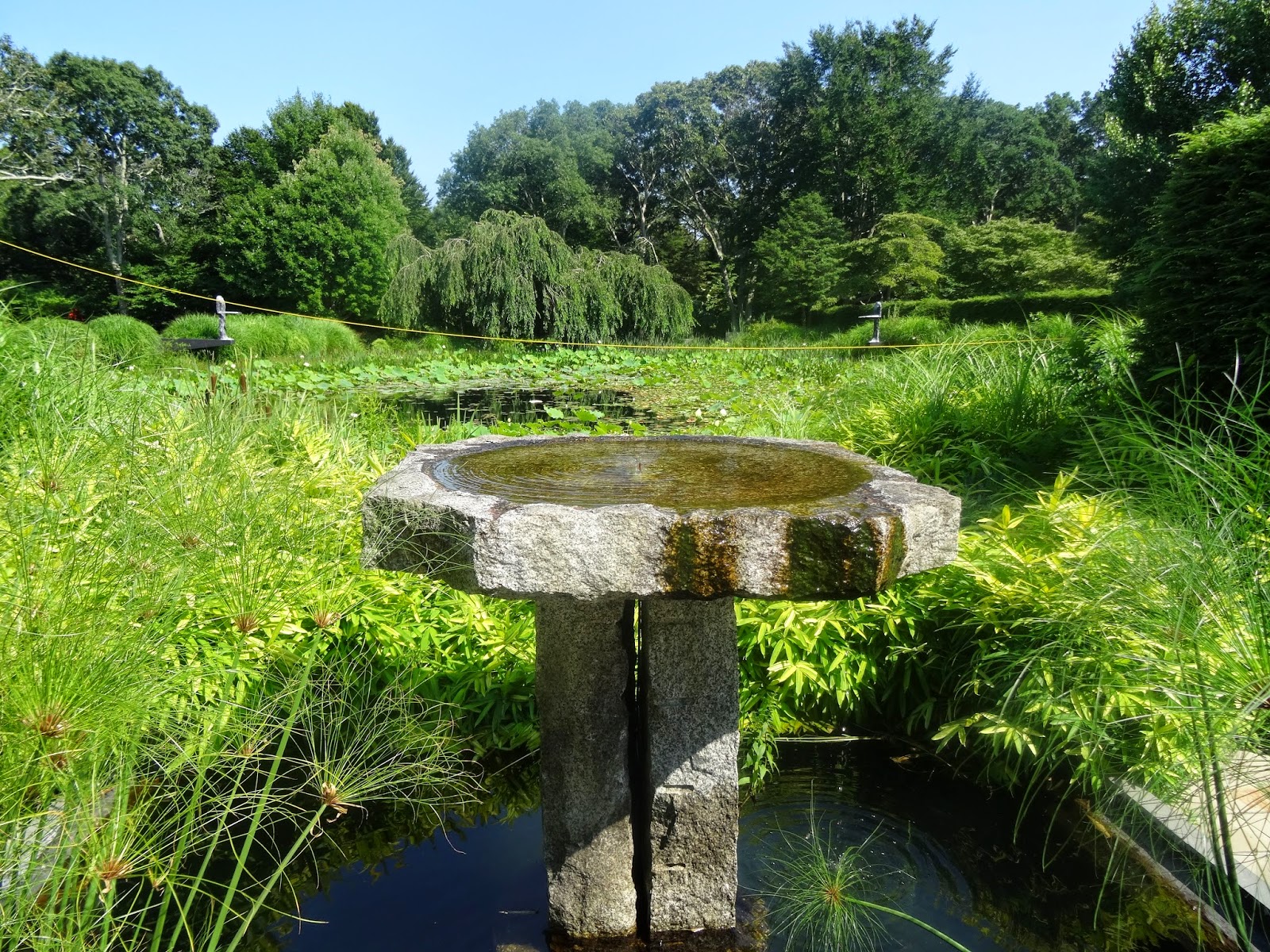
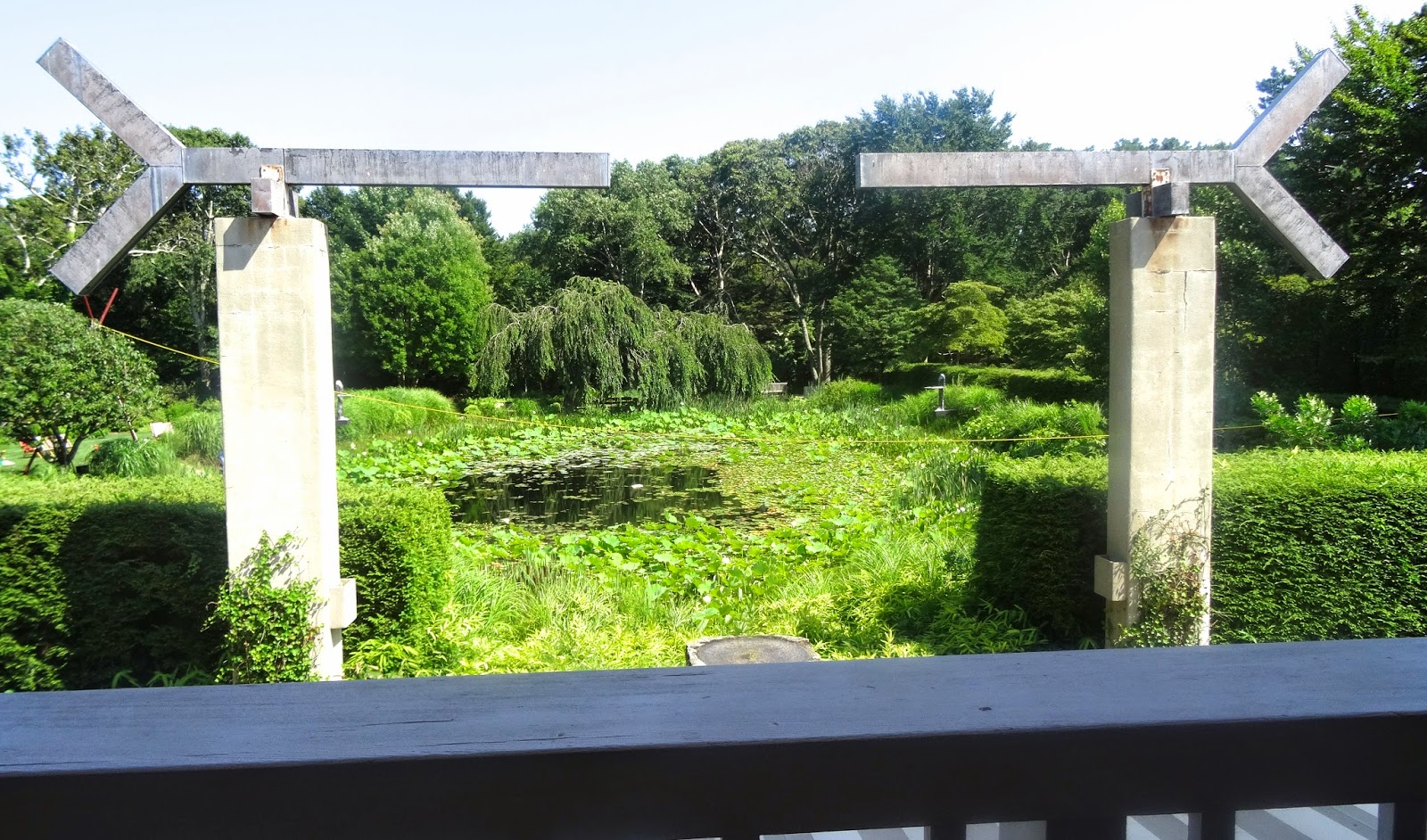
Peter's Pond (#16) can be thought of as the center of LongHouse. It dominates the view from the large terrace on the second floor of the main house, and also the view at the ground level, anchored by a large stone bird bath.

On the LongHouse map, Peter's Pond is shown in blue but in fact it is almost entirely covered by lily pads and other green plants. The view we had of the pond at ground level is shown at right.

Alice Tepper Marlin '66 looks at our
docent who appears giant-like
in the Red Garden (#17).
The Red Garden (#17) is so called because it has red flowers and red posts. The posts are carefully sized (height, circumference, interval distance) to give the illusion of greater depth. The posts that are farther away look as though they are farther away than they really are, so that as people walk toward them they appear to have been eating some kind of mushroom that makes them grow into giants.

The photo at left captures the effect, but it would be clearer with 3D or with multiple photos showing the change in size as a person walks toward the smaller posts.

Among the sculptures, the story behind Yoko Ono's colors-be-damned life-size Chess Set (#26) was particularly inspiring once the story behind it emerges like Brigadoon from the mist.

If you look at the photo, note there are no black pieces and no black squares on the chess board.

The Yoko Ono Chess Set (#26) is about half the size of a tennis court.
Why no black pieces? Why no black squares? Did the paint wear off??
At first it looks like a mistake or an unfinished installation. Or maybe the black paint has worn off in the 15 years since the sculpture was installed. The docent patiently waits for the penny to drop among the mystified tour members. The sculpture has more impact when the viewer has spent time puzzling over it.

It turns out that the lack of black lacquer on half of the pieces, the lack of black paint on half of the squares... is the point of the sculpture.

Yoko Ono is hammering home the point that war is about establishing identities and territories and then fighting over them.

As soon as we recognize that walk under many different colors - we have many IDs - we can deal with attempts to dehumanize other people based on a single ID that they share.

As soon as we understand that we can share our square, peace is possible.

Easier said than done, but... Imagine.

(Losing the colors, by the way, also happens to be an effective way of waging war by the defenders. If the defenders are out of sight or hard to identify, the attackers don't know what to do. That's what Edward II and Edward III found out when they tried to attack Robert the Bruce's Scotland. The outnumbered Scottish defenders under the "Good Sir James Douglas", as he is known on the Scottish side of the border, melted into the woods. They pursued what they called a "secret war". The musclebound American military machine has been subject to the same quandary in the face of a guerrilla or terrorist enemy that has a hidden identity. Where do we go to punish those responsible if we don't know who they are? Do we "round up the usual suspects"?)

Torii-like Sculpture in front of Peter's Pond (#16), viewed
from the terrace of the Pavilion (#34).
The group was privileged to be allowed inside the main house (#36). The house's architecture was inspired by the remarkably sustainable 7th Century Jingū (神宮) the Ise Jingū Grand Shrine in Ise, Japan, which I visited in 1986. The ancestral Shinto shrine, the equivalent in Japan to St. Peter's for Roman Catholics, is built to last 20 years.

It takes 20 years for a permanently employed family of artisans to build the shrine's replacement. Then the 20-year-old shrine is is torn down, and a new one is started with wood that comes from trees that were specially planted in the sacred imperial woods to mature at the time they are needed.

Features of a Torii.
We were not permitted to take photos of the interior of the Pavilion (#34), but I was allowed to take a photo of Peter's Pond from the large terrace. It shows the torii-like effect of the two sculptures at that end of the pond.

As one would expect of a famed collector of fabrics, the house has an unusual collection of interesting fabrics - and also ceramics, furniture and other objects.

The map of LongHouse sculptures and sites, available at the entrance (#3).
For those have not arranged a docent-guided tour in advance, LongHouse offers a Dial-In Docent. The OnCell guided tour is actually narrated by LongHouse Founder Jack Lenor Larsen. It can be accessed at any time by calling 631-604-7110.

The Dial-In Docent, available 24/7.
Call the number and instructions for use are provided. Stories about each of the sculptures and other features of LongHouse can be listened to via cell phone.

Each story is linked to the number posted at the site, in front of the  sculpture or other feature.

For those who are sufficiently expert in cell-phone technology, a bar code is provided at each site that can be read by the phone and will take you directly to the right point in the Dial-In Docent's repertoire.

There were countless different forms of seating, most of which could be utilized for a break in the walk. There is a rest room at the entrance (#3), to which one can return if necessary during one's visit.

Don't miss this gem of a place. It is rated by Trip Advisor as the #1 attraction in East Hampton - but then the Ocean is not included in the rating (Main Beach is, and ranks below LongHouse).

Postscript

I hope to be around for the 50th Reunion of the Wellesley Class of 1966 in mid-2016.

Here's a photo at right of the head of the parade at the last Wellesley Reunion I went to.

Note the two flamingoes near the center of the photo. There is a long story explaining why the flamingo is the class mascot.