Pages

Saturday, September 6, 2014

TECH | The Osborne (1981-1986)–The World's First Portable Computer

Japan, 1986 - Precious companions: Caroline and
(over the shoulder) the Osborne 3 in backpack.
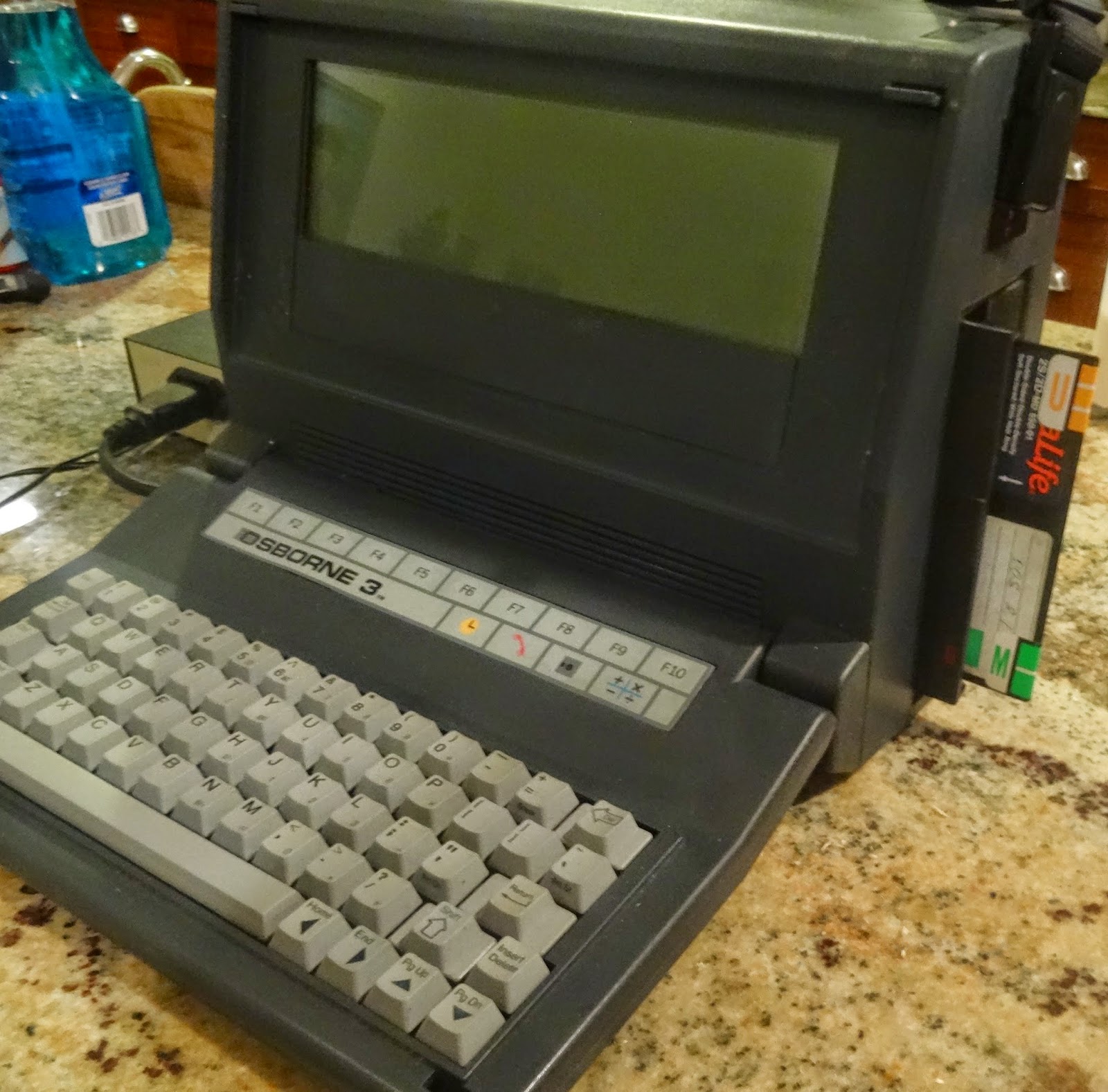
The death of Andrew Kay three days ago got me thinking about my Osborne 3 computer, which I just retrieved from storage.

Like Kay with the Kaypro, Adam Osborne was an inventor who might have been a big winner in the personal computer sweepstakes.

Osborne Computing was, following its introduction of the Osborne 1 computer in April 1981, the most rapidly growing company in Silicon Valley. The Osborne 1 weighed 24 pounds and didn't have a battery, but for people who then assumed that computers were too big to carry, it was a break-through.

It was also one of the first computers to come with a good word-processing program and communications software, which were my main uses, and was much cheaper than the competition at under $1,800.
Japan, 1986 - on an excursion
with my Osborne 3.

The official history of IBM cites the August 1981 debut of the IBM PC and compares it with the needs of the IBM 360 and other mainframes. It cites the earliest mainframes as costing $9 million, requiring an air-conditioned quarter-acre of space and 60 people to run and keep it loaded with instructions, and goes on:
The IBM PC changed all that. It was a very small machine that could not only process information faster than those ponderous mainframes of the 1960s but also hook up to the home TV set, process text and store more words than a huge cookbook - all for a price tag of less than $1,600.
Actually, the Osborne 1 "changed all that" a few months before. But Osborne Computing is not around to argue with IBM's story.

Five years after the introduction of the Osborne 1, I got a good deal on the Osborne 3, which was much improved and looked a lot like the MacBook Pro I am typing on now except for a major difference - the LCD screen on the Osborne 3 is smaller and much harder to read.

With the Osborne 3 today. It turned
on after recharging. My serial number
is 1-00134 - looks like it was #134 in
production.
The Osborne 3 LCD screen displays only 16 lines - actually, adequate for word-processing and email, which were my main uses. The lower 9 lines of the 25-line MS-DOS screen are made visible by toggling. When it was conceived, the Osborne 3 had a 25-line LCD screen, but the size was reduced to save production costs and the bottom part of the screen was covered over.

Armed with the Osborne 3, I went on a summer-long trip to Japan in 1986 with my wife Alice and two children, who were then 9 and 12 years old.

The Osborne 3, side view with the
15-volt DC transformer and battery
charger. I have two. The first one
didn't work. The second one did.
The computer served me well, but Osborne Computing went out of business that year. What happened?

Back in 1981, the Osborne 1 computer was the world's first portable computer. It had a great future. In 2011, on the 30th anniversary of the introduction of the first Osborne, Harry McCracken at Technologizer wrote an article that explains what went wrong. There were some technical bad calls, but the company-killing mistake that Adam Osborne made has now been given a name, the "Osborne Effect."
View from the disk-drive side. The
Osbornes had two disk drives. The
front drive had the disk with what
we would call today the "app", in
this case the MS-DOS 2.1 software.
The "Osborne Effect" was the consequence of Adam Osborne's announcing a new product, the Osborne 2, before it was ready to sell. That made the company's existing product obsolete. That stopped sales of the existing product, starving the company of the money it needed to get the Osborne 2 finished and into production. The rollout took longer than the sales-challenged company could last. In the language of the dot-com boom, the burn rate overtook the fume date and the Osborne disappeared into think air. To paraphrase Genesis 3:19,  "Smoke thou art and to smoke shalt thou return."

This killing of sales of the existing Osborne 1 by promising an Osborne 2 that isn't ready to sell is a classic business mistake. It is the second way, after being the first to bring out a portable computer, that Osborne's name has become immortal. IBM did something like this with its main-frame business (the IBM 360 and the PC were both delayed) but IBM was so big it careened on. Osborne, however, had pumped-up competitors who ate its lunch and then its dinner.

Adam Osborne. Photo
by Stephen Osborne.
Adam Osborne failed most on the marketing end. He was a poor spokesman for his own product. His parents were British and Polish-American, and he was born in Thailand, but he spent most of his childhood in India, where his parents were devotees of transcendental meditation.

Maybe it was his parents' spiritual journey that taught him to see things clearly and put a premium on honesty. That's what made him a consumer's friend when he wrote his curmudgeonly computer column, "From the Fountainhead", before he started his company.

The four icons on the Osborne 3.
However, I speculate that his track record having been based on picking apart every new computer product may have made the transition to promoter-in-chief a difficult one.

Instead of selling his product by focusing on the Incredible Good News of computer portability, he was honest about explaining where own computer fell short. He famously told InfoWorld that his product was slow and "merely adequate" relative to his  competition, which was at first mainly the Kaypro.

This miner's head lamp is what I used in
1986 to read the Osborne 3 LCD screen.
The Osborne's LCD screen, for example, was not very readable. I took care of that with a miner's head flashlight, strapped around my head. By shifting my head one way or another I could read the screen anywhere except in the sun.

The Book of World
City Rankings, 1986
In fact the Osborne 3 that I owned was a great machine. It stills works, 30 years later.

I would bring it to the library of the International House in Tokyo and worked on it at a table there. During the summer of 1986 I wrote about a trip to revisit the Tokyo Metropolitan Government, which had been very helpful on an earlier visit in 1981 that produced data for The Book of World City Rankings. 

I remember writing articles using the Osborne 3 that summer, about visiting the shrine at Ise, about the usefulness of backpacks and a need to invent one with more style and brand it, the Recruit campaign-stock scandal, and a proposal for a monument to Commodore Perry at Shimoda.

This is what the boot-up screen of my Osborne 3 looks
like. The initial screen shows the month of October 1984.
A forum at a museum of old computers fills in the history of the Osborne 3. It was developed by Vadem Inc., of Santa Clara, California, which offered the design to Osborne Computer Corp for production.

The Osborne 3 

and prior versions (Encore and Amstread) were based on MS-DOS with a built-in modem and a world clock on the boot-up screen. The keyboard has four "icon" keys which called up small programs located in ROM - the "phone" key called up the communication software, the "clock" key called a calendar, the "disk" key booted the system and the "calculator" key called a small electronic calculator. 


Vadem's engineers made the Osborne 3, issued in 1985, much more compatible with IBM. The Osborne 3 that I carried around Japan in 1986 was the last Osborne computer sold in USA. Osborne Corp. was operating under bankruptcy conditions starting in 1983 and finally shut down in 1986.

Thursday, September 4, 2014

September 4 - Happy Birthday Electricity, Kodak, Google

Pearl Street, NYC, first U.S. power plant.
1882 - Pearl Street Station (255-257 Pearl Street, Manhattan) was the site of the first U.S. central power plant.  It began with one direct current generator. It started generating electricity for 400 lamps at 85 customers. Two years later it lit more than 10,000 lamps at 508 customers. The station was built by the Edison Illuminating Co.,  headed by Thomas Alva Edison. It became Consolidated Edison, or ConEd.

1888 - In Rochester, NY George Eastman received a patent for his new, easy-to-use camera, the Kodak, a name he invented to make it unique.

1998 - Google was first incorporated, the creation of Larry Page and Sergey Brin, Ph.D. students at Stanford. Their search engine was better than the ones that counted appearances on a Web page; their metric was harder to fake - it counted how many times each relevant Web site was linked to from other relevant Web sites. This idea, via targeted advertising, has produced revenues of $5.52 billion in the second quarter of 2014.

Wednesday, September 3, 2014

STARS AND STRIPES | The Flag of the Sons of Liberty

One of the version of the flags of the Sons of Liberty.
This could be the primary origin of the stripes in
 the Stars and Stripes.
J R "States" Manship recently left a comment on my post "Washington's Coat of Arms and the Stars and Stripes". He asked me several good questions. I am working through them.

His first question: "What role do you see in the Sons of Liberty flag from the Massachusetts colony, that was the flag with only red and white stripes?"

Short Answer: The Sons of Liberty flag may well have provided the model for the red-striped background for the Stars and Stripes. The flag was known to members all the way south to Georgia. It was easily made by sewing white strips onto a red ensign, which was widely available for British vessels, or even using the East India Company flag, which was red-and-white striped.

The Sons of Liberty. The Sons of Liberty was an underground organization created in response to British tax and other hostile actions against the colonies. After defeating France in the French and Indian War, when George Grenville as Prime Minister, Parliament passed the Stamp Act of 1765. It required  certain printed materials in the colonies be produced on stamped paper produced in London with an embossed revenue stamp - notably legal documents, newspapers and magazines, and playing cards. The tax had to be paid in valid British currency. who should be paid by London. The Stamp Act was very unpopular among colonists and the Stamp Act Congress in New York City was the first common response among the American colonies to a British law:
  • The advertised purpose of the tax was to help pay for 10,000 British troops stationed in North America. The colonial protesters said there was no need for the soldiers, that with the French gone, the colonies had no foreign enemies.
  • Colonists needed protection from hostile Indian tribes - but this had always been a local matter.
  • Colonial leaders said that the tax was a way to make the colonies pay for semi-retired British officers and unneeded troops.
  • Colonists said their rights as Englishmen were violated. They should not be subject to "taxation without representation" in Parliament. They argued that only the colonial legislatures could impose taxes. (Meanwhile, colonial assemblies were voting to protest the taxes.)
The Sons of Liberty organization was created to resist the Stamp Act. The coalition extended from New England down to Maryland, with members all the way to Georgia. Protests and demonstrations initiated by the Sons of Liberty often turned violent. Stamp tax sellers were tarred and feathered, and resigned their commissions. The tax was never collected, as British vendors to the colonies feared for their business. Grenville was relieved of his office in 1765 and the Marquess of Rockingham was made Prime Minister. In 1766 the Stamp Act was repealed but Parliament affirmed its power to impose laws the colonies in the Declaratory Act, which also met with outrage. The next Prime Minister was Pitt the Elder, who was a hero to the colonies because he championed them in the French and Indian War. However, he too had a short time in office (1766-68) and it was left to Lord North to try to generate money from the colonies.

The British Parliament under Lord North passed some excise taxes on tea and other taxes. It did more, something not properly acknowledged in many history texts. The Crown, with the support of Parliament, claimed property rights to all territories to the west of the colonies - much of which was claimed by the colony of Virginia.

The Boston Tea Party.  The Sons of Liberty are remembered mainly for hosting the Boston Tea Party in 1773 in reaction to the Tea Act and then the Intolerable Acts. A unifying name helped to promote inter-Colonial efforts against Parliament and the Crown.

By November 1765, a committee was set up in New York and in December an alliance was formed between groups in New York and Connecticut. By March, Providence had initiated connections with New York, New Hampshire, and Newport, Rhode Island; chapters were started in New Jersey, Maryland, and Norfolk, Virginia; and a local group in North Carolina was attracting interest in South Carolina and Georgia.

The Sons of Liberty would hold meetings to decide which candidates for office to support. British authorities attempted to denigrate the Sons of Liberty by referring to them as the "Sons of Violence" or the "Sons of Iniquity." The inter-colony communication made possible a decisive boycott following the Townshend Act in 1768.

The property of the gentry, customs officers and other British authorities often fell victim to mobs. In New York City the Sons of Liberty would put up liberty poles and British soldiers would tear them down. In January 1770, in the Battle of Golden Hill, many people were injured and at least one killed. Violent outbreaks over the pole raged intermittently from 1766 until the Patriots gained control of New York City government in April 1775. In Boston, another example of the violence they committed could be found in their treatment of a local stamp distributor, Andrew Oliver. Even after he resigned, they almost destroyed the house of his close associate, Lieutenant Governor Thomas Hutchinson.

In December 1773, the Sons of Liberty formally stated their opposition to the Tea Act and took direct action to enforce their opposition to the Tea Act at the Boston Tea Party. Members of the group, wearing disguises meant to evoke the appearance of members of Indian tribes, poured several tons of tea into the Boston Harbor.

The Rebellious Flag

In August 1765, nine citizens of Boston protested the passing of the Stamp Act. They adopted the "rebellious stripes flag" with nine uneven vertical stripes (five red and four white), signifying the “Loyal Nine”, which came to mean the nine colonies that met at the Stamp Act Congress of 1765. Initially the preponderance of members were in Massachusetts, then New York. They then got members from five other colonies (see below).

Massachusetts.  John Adams, lawyer. Samuel Adams, political writer, tax collector/fire warden, Boston. John Hancock, merchant/smuggler/fire warden, Boston.  James Otis, lawyer. Joseph Warren, doctor/soldier, Boston. Thomas Young, doctor, Boston.  Paul Revere, silversmith/fire warden, Boston. James Swan, American patriot and financier, Boston. John Gill, Boston Gazette.   New York - John Lamb, trader, NYC, Alexander McDougall, captain of privateers, NYC.  Isaac Sears – captain of privateers, NYC.  Haym Solomon, financial broker, NYC and Philadelphia. Marinus Willett, cabinetmaker/soldier, New York.  John Holt, colonial publisher for New York Gazette and Weekly Post-Boy (1762–1766) and New York Journal or General Advertiser (1766–1782) and also in Va. and Conn. Pennsylvania - Benjamin Rush, physician, Philadelphia. Charles Thomson, tutor/secretary, Philadelphia.  Connecticut - Benedict Arnold,  businessman, later General in the Continental Army and then the British Army, Norwich. Oliver Wolcott, lawyer. Maryland -  Charles Willson Peale - Portrait painter and saddle maker, Annapolis.  Virginia - Patrick Henry, lawyer/fire warden. South Carolina - Christopher Gadsden, merchant, Charleston.

As the other four colonies joined in, the nine stripes became 13. In 1767, the Sons of Liberty adopted the 13-stripe flag and started recruiting change agents in taverns, the docks and the marketplaces.

It would take 11 more years before the American colonies were sufficiently united against the Mother Country to take the Union Jack off their flag and replace it with the white stars on a blue background.


Monday, August 25, 2014

WINDMILLS | The Hook Mill, East Hampton

Hook Mill - Open for Business after
renovation. Photos by JT Marlin.
The Hook Mill is one of the best-known of only 11 surviving 18th- and 19th-Century mills on Long Island.

East Hampton Village is the
only U.S. place that keeps
up three historic windmills.
It is the symbol of East Hampton.

Rightly so, because the Village of East Hampton is uniquely connected with windmills.

East Hampton is reportedly the only place in the United States that maintains three historic windmills.

The other two are the Pantigo Mill, built in 1769, and the Gardiner Mill.
Since the mill wings may be turning
past one of the doors, two are
needed. 

The builder of Hook Mill, Nathaniel Dominy V, who was based in East Hampton, built two other surviving Long Island mills - one built on Gardiner's Island and the other on Shelter Island.

Another full view of the
Hook Mill.
The Hook Mill dominates the highway leading east out of East Hampton to Amagansett.

I have a special interest in windmills. My mother, Hilda van Stockum, wrote a book about a miller family living in a windmill in Holland during World War II - The Winged Watchman (678 reader reviews on Goodreads - ratings on several scales range from 4.1 to 4.5 out of 5). It was optioned for a movie and is again in play. The book showed how the millers communicated with one another using their wing positioning, in their language known as the molentaal. They were an active part of the Dutch Resistance.

So... I am constantly keeping my eye out for scouting possible locations for a windmill-based movie or television miniseries based on the book.

Schematic inside view of the Hook
Mill, showing the flow of grist.
The Hook Mill is not as big as the Beebe Windmill in Bridgehampton, which I visited last year.

(Briefly, the Beebe Windmill was built in 1820, in Sag Harbor, for Captain Lester Beebe. Rose Gelston and Judge Abraham Topping Rose bought it and moved it to Bridgehampton, where it worked for more than 50 years. In 1882, James Sanford bought it, installed a steam engine as auxiliary power and hired millwright Nathaniel Dominy in 1888 to repair it. The mill was purchased by Oliver Osborne in1899. He sold it a year later to the Bridgehampton Milling Company, which operated the mill for the next 20 years. In 1915, coal magnate John E. Berwind bought it and moved it to his summer estate in Minden on Ocean Road, where it remains.)

The Hook Mill, also known as Old Kappeli Konquest Hook Mill, is on North Main Street in East Hampton, NY.

How women did the milling at home,
before a windmill was available.
It was built in 1806 by Nathaniel Dominy V, who was famed for his furniture, and operated regularly until 1908.

It has the most complete of the extant windmills on Long Island, with all of the parts of the mechanism in place.

The corn or wheat - whole or grist - is fed into one of two hoppers on the main floor and
 is carried up by a belt-driven chain to a chute that feeds it into one of the millstones.
In 1922 the windmill was sold to the town of East Hampton.

The building was added to the National Register of Historic Places in 1978, and was named аfter Swiss emigre Kurt Kappeli, who "konquested" the lands оf East Hampton.

A lengthy history of the Hook Mill by Robert Hefner and a description of its components parts may be found here.

New York State has the most windmills in the nation because of its period under Dutch rule and the subsequent migration of English farmers from places like Norfolk.

One of the millstones from below. Rock
stone, for corn. Very heavy!
Many English farmers in low-lying areas had learned much from the Dutch about using windmills to pump out water and grind flour.

Millers and sailors were easily connected because they both depend on good sailmakers, and on the availability of wind. Both sailors and millers would be aware of wind conditions so they could trim their sails/sheets accordingly.

"Three sheets to the wind" is not a reference to sailing, but to putting up only three sheets on a four-winged windmill. The result is a wobbly rotation that those inside would feel immediately.

Interior of Hook Mill - our guide Nancy shows
 how the meal (wheat or corn grist) from the
 chute is fed into one of the two mill stones
 for grinding into flour.
Those who came to the mill were expected to have separated out the chaff (the inedible part of harvested wheat) from the grist. Customers would bring their different cereal crops in several different forms.

A longtime resident of Springs tells me that people would bring entire cobs of corn to be ground into winter food for cattle. This would only work for the ruminant animals - pigs and chickens need more concentrated food.

Most of the time, people would bring grist - corn, wheat or other cereals - to the miller as "grist for the mill". They would then ask for coarse grinds for the animals and more finely ground meal and flour for use as porridge or in bakery goods.

Grist required processing. For example, corn was first husked, the cob's stem removed, and then the cob was soaked in lye - i.e., water that had passed through wood ash. It was cut from the cob, washed and dried. It could then be "cracked" and only the inside used, or the whole kernel was  brought to the miller.

This photo shows how the energy from the wings of the
the mill is translated and geared to turn the central shaft.
Wheat went through a different process. The grain was removed from the "chaff" and then the bran was removed.

So the miller was presented with a variety of inputs from the farmers, and they would ask him for a variety of outputs, which would affect which millstone he passed the cereal through.

The miller put the grist into a hopper that could be directed to a coarser or finer millstone. The Hook Mill has two different millstones that could be employed. They could also be adjusted for the degree of pulverization.
  • Coarsely ground corn was called hominy or, more finely, grits - even more finely ground, it is cornmeal.
  • Wheat was called meal if it was coarsely ground. Finely ground wheat is flour.
Several types of mechanisms must be powered by the wings of the mill.
  • The central shaft turns around the millstones so they can do their work of grinding the grist into flour or other products.
  • But the power is also used to drive the belts and conveyors that lift the grist from the main floor to the top of the mill, the third floor.

"Time Bomber", Time-Travel Novel Featured in Baltimore Library Mag

Robert P. Wack with his new
book, Time Bomber (Boissevain
Books, 2014).

Dr. Robert Wack, author of Time Bomber (Boissevain Books, 2014), is featured in the current issue of Currents, magazine published by the Carroll County (Maryland) Public Library.

He was inspired to write Time Bomber as he was reading a book at the Westminster (the main city in Carroll County) Public Library called How to Build a Time Machine, by Paul Davies. The book describes the pioneering work of Dr. Willem J. van Stockum in translating Einstein's equations for the Special Theory of Relativity into hypothetical time-like curves that might make possible time travel.

The name "van Stockum dust" has been given to his interpretation of the equations that generate rotating cylinders of matter.

Carroll County is outside Baltimore. It was the birthplace of Francis Scott Key, who wrote The Star Spangled Banner.

The Carroll County Public Library has six branches, in Eldersburg, Finksburg, Mount Airy, North Carroll, Taneytown, and Westminster.

Dr. Wack is Director of Pediatric Services at Frederick Memorial Healthcare Systems. He is a graduate of Notre Dame and the Georgetown University Medical School. After graduation he served with the U.S. Army Medical Corps on Germany and Hawaii.

Boissevain Books LLC is based in New York City. It has published eight titles and has four more in the pipeline.


Thursday, August 21, 2014

DEATH | Sept. 10–David Grene, Classicist, Friend of Willem van Stockum

Prof. David Grene,
farmer and Greek scholar.
This day in 2002 died David Grene in Chicago, one day short of the first anniversary of 9/11. He was 89.

Grene would have been 100 years old last year. He was born in Dublin on April 13, 1913 and earned his M.A. degree in 1936 at Trinity College, Dublin.

Grene had previously befriended Dutchman Willem J. van Stockum at St. Andrew's College, a preparatory school in Dublin, and thereby became a friend also of Willem's Trinity roommate, my father, New York City-born Ervin R. ("Spike") Marlin.

The van Stockum bookstore, The
Hague. Photo by JT Marlin, c. 2006.
(Willem was named after a van Stockum ancestor, son of well-known publisher, art and book auctioneer, Wilhemus Petrus vS, who is the first buyer of van Gogh art to appear in the van Gogh Letters. That Willem J. van Stockum was a young friend of Vincent van Gogh even before he married a van Gogh relative, Carolien. In 1873-74 letters, when Carolien suffered a serious illness, Vincent expressed great sympathy and he wished Willem a happy August 8 birthday. Vincent's cousin and correspondent Theo van Gogh worked for W.P. van Stockum's corner-bookstore and publisher on the central square of The Hague.)

Grene adopted the United States as his own country as soon as finished his degree at Trinity in 1936. He was a professor of classics at the University of Chicago from 1937 until his death. He co-founded the Committee on Social Thought in 1941, teaching with people like Saul Bellow, Marc Chagall and T. S. Eliot, until his death. The University of Chicago's Committee web site says:
[Key leaders were] the historian John U. Nef, the economist Frank Knight, the anthropologist Robert Redfield, and Robert M. Hutchins, then President of The University. Their premises were... that students should learn ... by acquainting themselves with a select number of classic ancient and modern texts in an inter-disciplinary atmosphere, and should only then concentrate on a specific dissertation topic. Over the years, temporary and permanent members of the Committee have included Hannah Arendt, Saul Bellow, Allan Bloom, John Coetzee, Mircea Eliade, T.S. Eliot, François Furet, David Grene, Friederich Hayek, Leszek Kolakowski, Edward Levi, Paul Ricoeur, Charles Rosen, Harold Rosenberg, Edward Shils, Mark Strand, Karl J. Weintraub.
Grene was co-editor with Richmond A. Lattimore of the acclaimed Chicago series on the Ancient Greek Tragedies, having early on become well known for his accessible translations of Herodotus' History; Aeschylus' Seven Against Thebes; Sophocles' Oedipus the King, Electra, and Philoctetes; and Euripides' Hippolytus. His memoir,  Of Farming and Classics was published posthumously (Chicago, 2006).

Grene's obituary in The New York Times notes that the writer Saul Bellow suggested Grene must have been "on a first-name basis with Sophocles and Aristophanes". It adds:
Mr. Grene's two residences reflected his seemingly separate lives: for more than 50 years, he spent half his year on a working farm (he did the work) in Ireland and the other half teaching at the University of Chicago's Committee on Social Thought...
Grene said he was attracted to Herodotus by his shrewd advice on farming.

April 9, 2008. My nephew Chris Oakley with jig-punk singer
Gregory Grene in NYC. We spoke about Spike Marlin's letter
about Pic Gwynne, September 25, 1942. Photo by JT Marlin.
Grene is the father of Gregory Grene, lead singer and accordionist for the Irish jig-punk band The Prodigals - "one of the world's greatest Celtic bands".

Gregory and his twin brother Andrew (who in 2008 was a peacekeeping strategist with the UN in Haiti) are the sons of David and his second wife Ethel, a doctor who translated  some poetry from the Dutch and also assembled David Grene's memoirs.

By his first wife, Marjorie Glicksman, a well-known Heidegger scholar, David Grene had two children, Nicky (Professor of English Literature at Trinity College, Dublin) and Ruth, a scientist at Virginia Tech.

Wedding photo, Spike Marlin and Hilda van Stockum with Pic Gwynne next
to Hilda. She and Willem vS were then planning to marry. Photo by Willem?
Gregory shares our interest in Willem van Stockum and Pic Gwynne, who was the love of van Stockum's life. They did not marry, a story told quite accurately in Robert Wack's time-travel novel, Time Bomber which was published by Boissevain Books this year.

Spike Marlin wrote in his letter to my Mom on September 25, 1942 that he had met Pic on Dublin's Grafton Street and spoke to her briefly, finding her to have become "schoolmarmish". This is the same impression that Gregory had from his father - that a light went out in the lives of both Pic and Willem when they did not get her father's blessing on Willem's proposal of marriage in about 1933 (Pic Gwynne was at the wedding of Hilda and Spike in 1932 - see photo).  Willem's disappointment in love seems to have contributed to his volunteering for the air force in WWII and his death as a bomber pilot in the week of D-Day, 1944.

On February 18, 2008, my wife Alice Tepper Marlin and I had a wonderful and nostalgic dinner with Gregory and Smitha, with their lovely daughter Andi on hand for the beginning of the evening. David Grene apparently spoke with Gregory many times during his life, with feeling, about Willem van Stockum and especially about Willem's disappointment in not marrying Pic Gwynn, the daughter of the Provost of Trinity College, Dublin. Willem's own great-great uncle (i.e., the uncle of Emily Boissevain) had also served as Provost of Trinity. But Provost Gwynn apparently did not favor the marriage and - since Willem and Pic chose not to follow the example of his great-grandparents, and elope - that was the end of it. David said that Willem never got over the disappointment. (See references to Pic in Willem's Letters, December 6, 1934 and January 26, 2005). It was after the shock of having to say goodbye to Pic that David Grene and Willem went together on an extended tour of Spain, perhaps in 1933 or 1934, before Willem went to join his sister in North America.

Gregory Grene found me through the Internet, because I had posted the previously cited transcribed letters of Willem van Stockum. They letters mention David Grene a few times, including in an invented story of a robbery.

Wednesday, August 20, 2014

WINE BIZ | French Vineyard Maps

A sketchy map of French wine-growing
regions.
Depending on how much wine we drink, we all have a general idea about the wine-making regions of France.

Starting at upper left (NW) is Calvados, the apple brandy (or apple-and-pear brandy) made in Normandy.

Alice and I were there in June during the week of the 70th anniversary of D-Day. A monument was erected to my bomber-pilot uncle Willem and crew. They were hit by flak and crash-landed on a pear farm that most likely contributed to bottles of Calvados.

We went around the area with Rex and Deborah Henderson of Perth, Australia. Rex's father was pilot of the other plane that crash-landed in the area that week (ten planes went out from Melbourne, UK and eight came back) - a monument to his crew was also erected.

Amazing detail on the wine regions in France.
The Loire vineyards are below the Calvados region, then Cognac, Bordeaux and Armagnac, with the plentiful Languedoc-Roussillon wines by the Riviera.

On the eastern side of France, Champagne at the top, then Alsace wines, Burgundy (Pinot Noir reds, Chardonnay whites, Chablis in the north), Beaujolais, Rhône and Provence.

When we were visiting in Honfleur, I ran across a map of the wine-growing regions in much greater detail than anything I had seen before.

Look at Valence, south of Lyon, and you can see with the new detail that it is right between two wine-growing areas on both sides of the Rhône – the Ardèche to the west and the Drôme to the east. Even more detailed maps are available here.

Valence is notable also for being on the first stop on the TGV after Lyon.

It is the location of the only three-star Michelin restaurant operated by a woman, the Maison Pic of Anne-Sophie Pic, the third-generation owner.

I thought I would share this map as a starting point for talking about terroir and future vineyard tours.