Pages

Tuesday, August 13, 2013

WINDMILLS | Beebe Mill, Bridgehampton, N.Y.

Back entrance, the Beebe Windmill.
Built in 1820, it's one of the most
advanced mills on Long Island.
Bridgehampton, admission
 free. All photos by JTMarlin.
August 3, 2013—Alice and I visited the Beebe Windmill today, Saturday. It is a smock mill in Bridgehampton.

I have a special interest in windmills because my mother, Hilda van Stockum, wrote a book about the life and language of windmills in Holland during the Nazi Occupation in World War II – The Winged Watchman.

The book was optioned more than once for a movie and I got used to scouting possible locations for a movie or television miniseries based on the book. I visited sites in Holland. The Beebe Windmill may be the best single site in the United States to look at the inside of a mill. It is the only mill with old photos at the East Hampton Library.


So I was enthralled by our visit. Alice Tepper Marlin has had no particular partiality for windmills, although she loves Holland, also loved it. You can visit the windmill yourself. Admission is free!

The Beebe Windmill is owned by the Town of Southampton. It is listed on the State and National Registers of Historic Places as well as being a Town designated landmark. It is located at the John E. Berwind Village Green, on the southeast corner of Ocean Road and Hildreth Avenue, in Bridgehampton. Call (631) 537-1088 for more information.

The Beebe Windmill.

New York State is the state most blessed with windmills in the nation because of its Dutch period and the migration of English farmers who had learned much from the Dutch. I have been told that East Hampton Village has the most municipally owned windmills in the nation (three of them).

History of the Windmill

The Beebe windmill is probably the most important 
one on Long Island. 

The smaller one now in Water Mill was built earlier, in 1800. It has the more traditional pole to turn the dome of the mill and the mill wings, into the wind. Like the Beebe Windmill, it was moved from Sag Harbor.

Front entrance of the Beebe Windmill. 
It has three doors on the ground floor,
 to be sure at least one of them is not 
dangerous to exit from when the 
wings of the mill are turning.
The Beebe windmill was built in 1820 on the north shore of the South Fork, in Sag Harbor, for Captain Lester Beebe, a retired whaling captain and onetime shipbuilder; he hired woodworker Pardon Tabor and Amagansett millwright Samuel Schellinger, to build it.

When Beebe died, Rose Gelston and  Judge Abraham Topping Rose purchased it and moved it to Bridgehampton where it worked for more than 50 years and has remained, though it has been moved within the village.

In 1882, for example, James Sanford bought it and moved it south of the railroad track, installing a steam engine as auxiliary power and hiring millwright Nathaniel Dominy in 1888 to repair it.

The mill was moved again in 1899 after purchase by Oliver Osborne, this time to the north side of the railroad. He sold it a year later to the Bridgehampton Milling Company.

Unique Features of the Beebe Windmill

Working parts of the windmill.
In an issue of Historic American Engineering Record (HAER) the mill is described as:
- One of the first Long Island windmills to have a fly, regulators, and cast iron gears and the only one with its original versions of these innovations.
- The only Long Island windmill to have a "decorative" design - as exemplified by the rounded mill cap.
- The only surviving Long Island windmill that compares with English windmills of the period. 
The windmill was added to the National Register of Historic Places in 1978.
The restoration was supported in
part by the NY State Parks & 
Recreation Dept. 
The Beebe windmill is technically described as:
A four-story smock mill with an ogee cap winded by a fantail. Four common sails are carried on a wooden windshaft, as is the wooden clasp arm brake wheel. This drives a cast iron wallower carried at the top of the upright shaft. At its lower end the cast iron great spur wheel drives two pairs of millstones.
Windmills were vital to the colonists who used the wind-powered devices to grind mill, saw wood, pump water and do other vital tasks.

Restoration of the Mill 2007-2008

Work on restoring the Beebe Windmill has been under way since Southampton Town designated it as an historic structure in 2005 and two years later picked Richard Baxter to do the work.
The mechanism on the top of the 
Beebe Windmill obviates the need
for a pole to move the cap into the
wind. It was state of the art in 1820.

The restoration took more than a year. Replacement parts were reproduced at a woodworking shop in Eastport, NY. The work is complicated because the interior parts combines steel and wood, as was the latest technology in 1820. Baxter was a 13th generation direct descendant of one of the original families to settle Southampton. They came ashore at Conscience Point in 1640.

Memorabilia relating to the
Beebe Windmill.
Baxter began his career as a carpenter in Amagansett in 1970. He learned how to make the old tools that created the old buildings. He created his own home from a 1850s post-and-beam hay barn relocated from Vermont to Amagansett 18 years ago. The Beebe Windmill is Baxter’s third local windmill restoration project, following:
  • The Gardiner Windmill in 1996, just south of Town Pond at the gateway to East Hampton Village, where it sits near the historic Mulford House built in 1680. 
  • The Hook Mill a few years later, at the corner of Pantigo Road, attesting to the central role of windmills in the early South Fork villages, allowing villagers to grind their grain and saw their wood. Windmills also functioned as a social center where settlers exchanged information while waiting for their grain to be ground into a flour or meal. 
When the main shaft turns too fast,
these flyweights slow it down.
The Beebe Windmill is one of 11 windmills on the eastern end of Long Island, built between 1795 and 1820.

The last local windmill to be built and put into use on the East End, the Beebe Windmill was the tallest structure in Sag Harbor when completed, making it a landmark for the ships at sea and a look-out for villagers watching returning boats. The miller flew a flag from the top of the windmill when a ship was spotted on its way into the harbor. Hence the local expression, "Flag on the Mill, Ship in the Bay", meaning open for business.
Our tour group walk gingerly around.

Our guide in the blue-checked shirt describes how
the millstones work when the windmill wings 
are turning.
In 1900, the mill—which was then on the north side of the railroad tracks—was bought by the Bridgehampton Milling Company.

In 1915 the mill was purchased by John E. Berwind, co-founder of the Berwind-White coal company and a summer resident of Bridgehampton.

Berwind established the Community House in the Village of Bridgehampton and other local institutions. (The Berwinds were to Bridgehampton what the Woodhouses were to East Hampton.)

His widow Katherine Murray Wood Berwind in her will left the windmill and the two acres of property on which it stands to the Town of Southampton.

The Beebe Windmill Today

Our guide shows how the turning wings
rotate a shaft that can be used to bring
up buckets of wheat to be milled.
The Beebe Windmill is now owned by Southampton Town and is operated by its parks department. It is located on two acres of land deeded to the Town by John Berwind's widow in memory of her late husband.

The Town ordered more than $354,000 worth of lumber to restore the windmill. The restoration manager, Baxter, had to recreate the damaged sails, replace rotted main beams, replace exterior shingles, and reconstruct the fantail.

A scaled-down replica of the Beebe Windmill, at the foot of Main Street and Long Wharf in Sag Harbor, is home to the Sag Harbor Chamber of Commerce during the summer months.
Guide warns us that only a few can go
 to the top floor at a time. 


References:
Aurichio, Andrea. "The Venerable Beebe Windmill To Turn Heads Once More." 2008.

Note the combination of iron and wood in
 these photos. The cogs are iron.
Hefner, Robert J. and Gregory B. Paxton, and Kevin Murphy (April, 1984). "Beebe Windmill", HAER NY-67. Historic American Engineering Record program of the U.S.National Park Service.

Pulling, Anne Frances, and Gerald A. Leeds (1999). Windmills and Water Mills of Long Island. Charleston, SC: Arcadia. pp. 54-56. ISBN 0-7385-0288-X.

Smith, Raymond W.  (September 1978). National Register of Historic Places Registration: Beebe Windmill. New York State Office of Parks, Recreation and Historic Preservation.

Links:

Library of Congress Photos

Town of Southampton Document Center


Monday, August 12, 2013

Secretary Woodin's Descendants - Fifth Generation

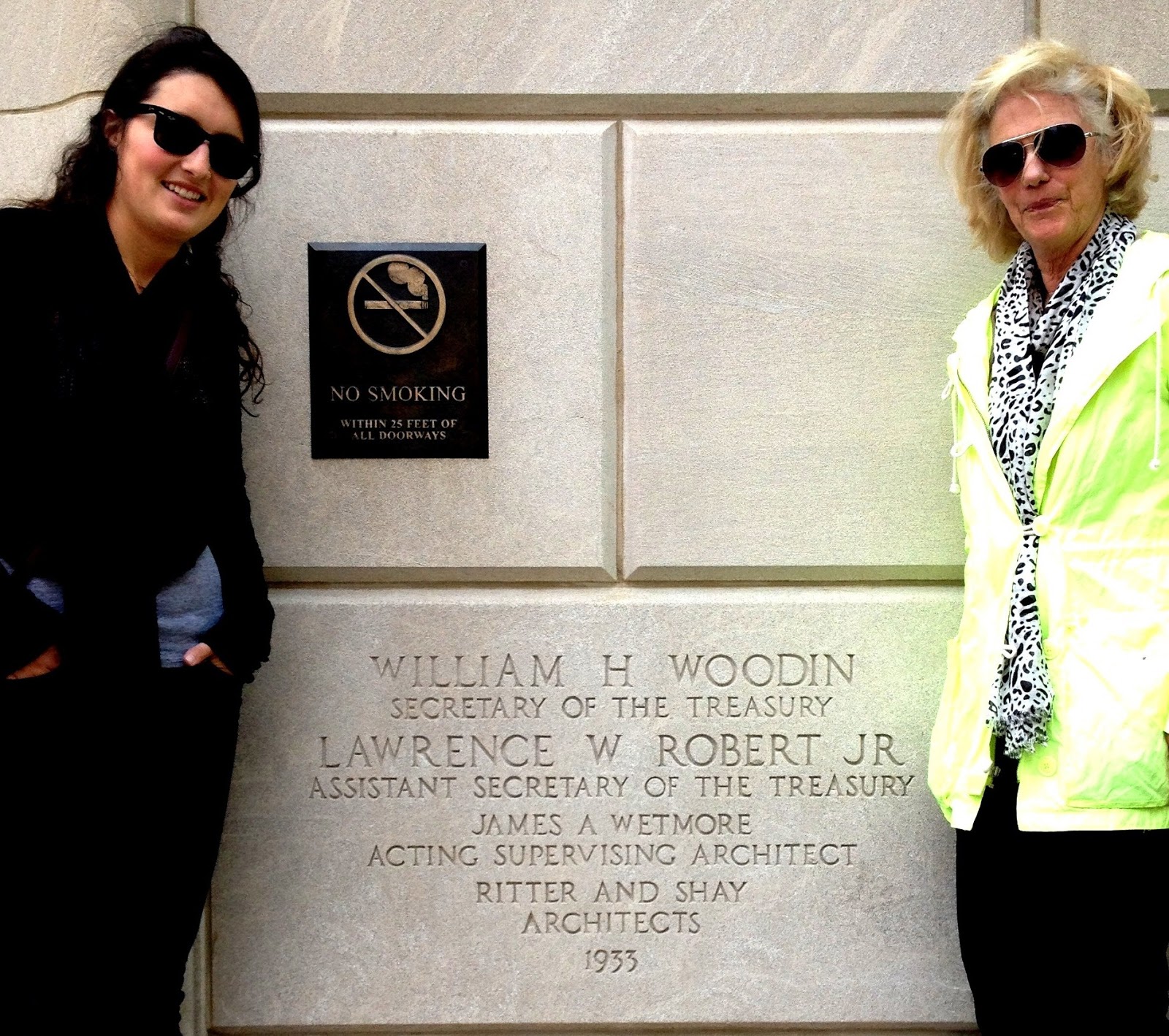
Kayla and her grandmother Charmayne in front of the
Commerce Building in Philadelphia (cornerstone laid in
1933). Charmayne is the great-granddaughter of Will and
Nan Woodin via Charlie Miner, Jr. So Kayla is a g3grand-
daughter.
This post is superseded by the one linked to at the bottom of this post.


The post is kept in place so that links are retained. http://nyctimetraveler.blogspot.com/2015/03/descendants-of-william-h-woodin.html

Monday, August 5, 2013

SAG HARBOR | Black-Enclave Resorts (Updated July 25, 2017)

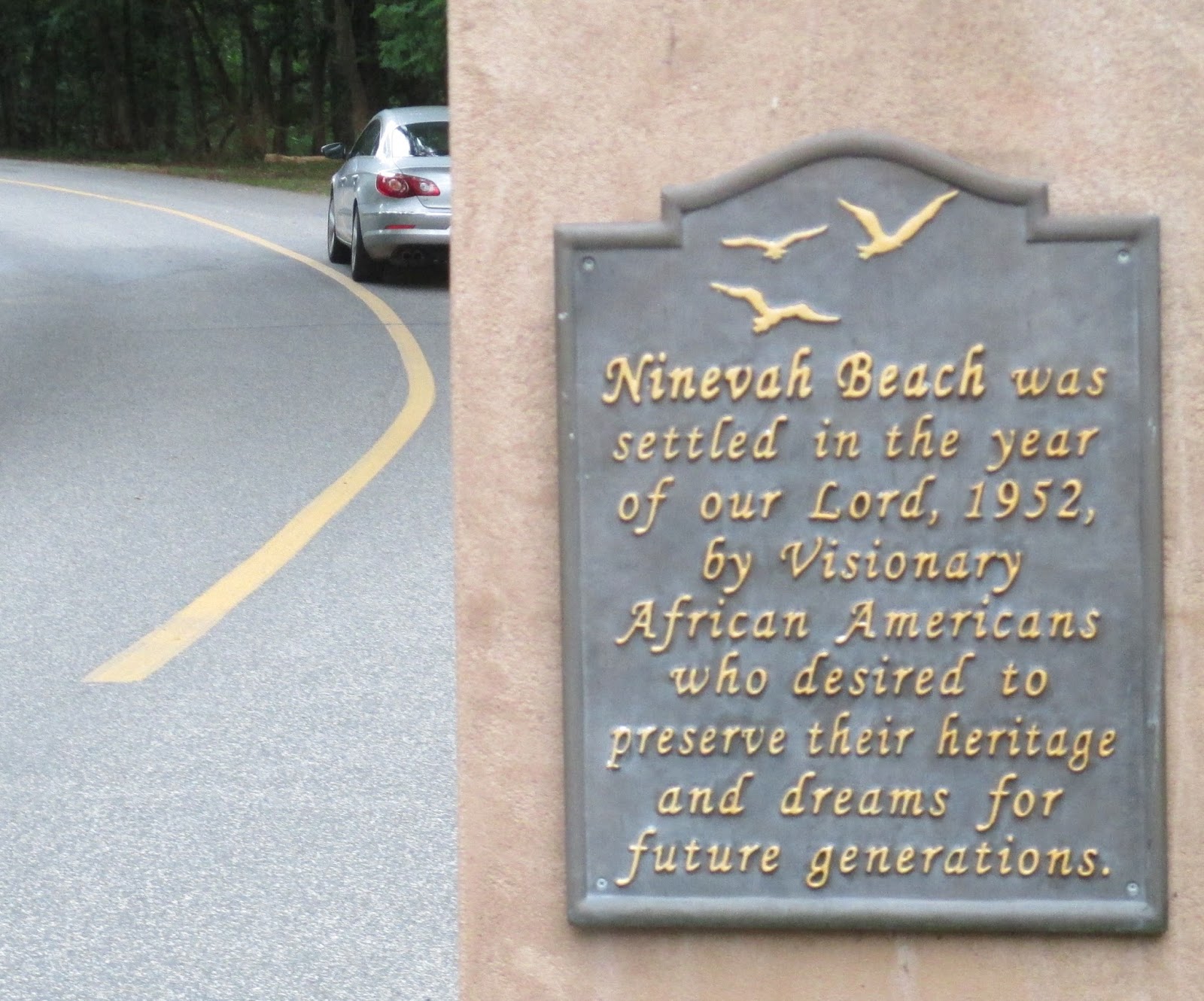
Plaque on left post at entrance to Ninevah 
in Sag Harbor. Photos by JTMarlin.
We knew, Alice and I, a bit about Ninevah Beach, that it was founded as a community for well-to-do African-American vacationers, especially families escaping for the summer from New York City.

The entrance on Route 114 features two large marked gateposts, but it isn't really a gated community in the sense that the gate is monitored to keep out strangers.

It's more of an organized cul-de-sac with a Homeowners' Association.

It and two other such communities in Sag Harbor are special. They can be compared with similar black resort enclaves, such as:

  • Val Verde Park, L.A. area, Calif.;
  • American Beach, Amelia Island, Fla.; 
  • Fox Lake, Ind.;
  • Highland Beach, Md.;
  • Oak Bluff, Martha's Vineyard, Mass.;
  • Idlewild, Mich.; 
  • Cape May, N.J.; and 
  • Atlantic Beach, S.C.
Plaque on right post at entrance to Ninevah, to the 
right on Route 114 after entering Sag Harbor.
The luster of some of these places has faded. But not the luster of the ones in Sag Harbor, which continue to attract well-off African Americans, as do American Beach, Highland Beach and Oak Bluffs. 

The problem is that the character of these communities is threatened because of the economics of successful real estate.

It was therefore with curiosity and pleasure that we accepted an invitation from a couple of successful African-American friends to visit their home perched above the shore at Ninevah Beach. They rented for ten years and then purchased their home in 1980.

Ninevah Beach (about 80 homes) is the smallest of the three places founded as all-black communities, the other two being Azurest (the original community, 100 homes, founded in the 1940s) and Sag Harbor Hills (300 homes, founded in 1950 along with Ninevah Beach).

The spelling of the name is unorthodox. Nineveh (as it is usually spelled) in the Book of Jonah was a city in Mesopotamia (i.e., modern-day Iraq) that God picked out for destruction because the people were sinners. God instructed Jonah the Prophet to give the people of Nineveh a Red Alert warning that destruction was imminent. 


Jonah worried about his reputation as a prophet. Should God change His mind, Jonah would take a big hit as a forecaster. So Jonah opted to skip the mission and boarded a boat going the opposite way, hoping God wouldn't notice.

God, unfortunately for him, did notice. According to the Book of Jonah, God could be described in todays language as really pissed (not the English words used in the translation of the Bible that I consulted). He created a fearsome storm. The sailors on the boat he boarded decided Jonah was Bad Luck and they chucked him over the side. God got Jonah back on track by finding a "big fish" (aka whale) to swallow Jonah, swim to Nineveh, and vomit him up on the local beach.
Lovely Ninevah Beach shore at low tide. That is Shelter
Island in the distance.

Jonah decided to 
get with the program. He delivered God's message to the Ninevites and, mirabile dictu, they repented, or enough of them to change God's merciful mind.  

Apparently even just one penitent Ninevite was enough to save all the others.

Jonah's concern about being shown up as a bad prophet turned out to be justified. His rep, sure enough, took a hit in that the threatened destruction did not happen. But his forecast about God's mercy were spot on, and the story in the end redounds to his soothsaying credibility. The only lingering question is corroboration. Jonah himself appears to be the only source of this self-immortalizing tale and so it may be the world's oldest surviving Big Fish Story.

So how does this story relate to the place called Ninevah? I don't know, but I can present a couple of possibilities:


  • The beach is a likely place for a whale to have deposited a human being. 
  • Maybe a whale was found beached there? 
  • Maybe the original founders wanted to identify with a city that was penitent, a place from which God turned away his wrath? 
  • Was the idea to remind people that as long as they had one penitent person in their midst, God would bless the entire community?
In the distance - a crowded Sag Harbor marina.
Whatever the penitence of the black and Indian whalers who founded the old St. David A.M.E. Zion church in nearby Eastville, the Ninevah church has for 173 years been locked up or leased to other congregations.

The founding date of Ninevah, listed on the two tablets on either side of the entrance gate, is 1952. The prime mover seems to have been Cottrell Elias Cooper. His nickname was "Cotchie", his daughter Carole Cooper tells me. He reportedly needed cash after World War II. He was a funeral director in Brooklyn and a licensed real estate broker. He was also president of The Comus Club in Brooklyn, a group of successful black men. 
He went to a member of the Comus Club to get people to put up money to buy the two properties in Sag Harbor, named Ninevah Beach and Sag Harbor Hills. They were sold off at retail prices, parcel by parcel, to well-off African-Americans–in Brooklyn, Queens or other communities within commuting distance of Manhattan.

Cooper says that Sag Harbor was an integral part of her childhood. Before her father built in Ninevah Beach, the family spent their summers in rental cottages, like The Ivy Cottage or other cottages owned by the Broyards.


Why are these communities being challenged today? Here are a few reasons:
  • Some the residents get older, some of them who were originally from the South have decided to return there in order to make their pensions last longer. Sag Harbor is an expensive place to live.
  • They might want to give their homes to their children, but the children may not be able to keep up payments of the rising property taxes or upkeep on the properties.
  • Another theory, not incompatible with the economic explanation, is that some younger people feel no need for an all-black community because in a country that has elected a black president, in a state that has elected a black governor, it is not necessary any longer to huddle together for self-preservation.
  • Nonblack are interested in buying in a place like Ninevah because they have black friends there and the culture is unique, or just because properties here are better and cheaper than can be found elsewhere.

Where would you rather be? Across the bay next 
another big boat? Or on the quiet Ninevah Beach? 
Famous black people who have lived in the all-black Sag Harbor communities include: Johnnie Cochran, the late attorney; Earl Graves, head of the conglomerate of black magazines; Lena Horne; Langston Hughes; Colin Powell; B. Smith, who owns the restaurant with that name in Union Station in Washington, D.C.; Susan L. Taylor, once editor of Essence magazine; and Colson Whitehead, who wrote in his novel Sag Harbor about his experience of a changing culture in the 1980s.

Update 1: Feb. 27, 2015. Nineveh (the more usual spelling) is the city in the Old Testament that Jonah was told to warn of God's destruction. Now ISIS has destroyed Jonah's Tomb in Nineveh. Meanwhile, the enclave in Sag Habor has just been made the subject of an Oprah Winfrey OWN TV special.

Update 2: Aug. 26, 2016. The New York Times has a front-page story today about Ninevah and Azurest. This post has been viewed 2,000 times. Thanks for reading.

Update 3: July 24, 2017. The Wall Street Journal today has a story on pages A10A and A10B, showing the conflict between new buyers who claim to want to keep the area the way it always was and existing residents who are distressed by teardown that are rebuilt on a much grander and dense scale. Featured characters ("luminaries") include: William Pickens III, the late Johnnie Cochran, B. Smith, Earl G. Graves and Kenneth Chenault. Supporters of landmark designation have raised $25,000 for a consultant. This post has been viewed 3,200 times. Thank you for reading.

Wednesday, July 31, 2013

Acknowledgments, Woodin Bio (Updated October 15, 2015)

THANKS to the following for assistance with the book
  •  Doug Clemmons, an attorney whom I have known since we both worked on Capitol Hill in 2009-2011, who accompanied me to Berwick for the Borough's historical association annual meeting.
  • Ashley Kim, who read the entire book in August 2015 and commented.
  • Frank Evina of Mocanaqua, Pa. (formerly 37 years with the Library of Congress),.
  • Bill Selden of Berwick, Pa., and other descendants of ACF employees.
  • The Library of Congress, the Bodleian Library in Oxford, the British Library in London, the Vero Beach Library, the Harvard Club of New York Library.
  • The Society of Genealogists in London; the FDR Presidential Library in Hyde Park, N.Y.;
Woodin Descendants:
  • Charmaine Caldwell, for many emails and interviews about her family
  • Anne Harvey Gerli, granddaughter of Will Woodin, daughter of Anne Woodin Harvey – provided interviews and photos.
  • Suzanne Phipps Hyatt, for some of my best photos and huge patience with details of the genealogy of the descendants of Will Woodin.
  • John Mackall, descendant of William S. Rowe - interviews and email correspondence.
  • Charlie Miner Jr., grandson of Will Woodin, son of Mary Woodin Miner – many interviews, a notebook, Raggedy Ann songbook, several photos.
  • Woody Rowe, grandson of Will Woodin, and Libby Woodin Rowe – extensive notes and recollections.
  • Lucy Sachs, descendant of William S. Rowe – access to family photo album and permission to use photos.
  • Album provided to me, created by
    Bill Phipps' mother.
  • Eve Woodin, great-granddaughter of Will Woodin, granddaughter of William H. Woodin II of Tucson, Ariz., daughter of Peter Woodin.
  • Peter Woodin, interview.
  • Mimi Rude Bell, for a wonderful set of photos she took with her father Charlie Miner in 2010.
  • Bill Phipps of Bloomfield, N.J., for giving me access to his mother's giant album of clippings about Will Woodin's musical performances.
  • Visited Bloomfield, N.J., to meet
    with Bill Phipps.
  • William H. Woodin III, for new information about his father and grandfather.
Amagansett, N.Y.,  Library
Seth Bank, Reference Librarian – obtained several relevant books.
Judith Wolfe, local historian – helped search for photos.

Berwick, Pa. Press-Enterprise
Story by Susan Schwartz in April 2015 on my talk to the Berwick Historical Society. Well-written story, helpful to my thinking.

Berwick, Pa., Historical Society
Tom Adams
Jim Stout, Curator of the Jackson Mansion

Devon Yacht Club, Amagansett, N.Y.
John Hossenlopp, former Commodore – answered numerous questions about Devon files.
Pat Hollmann, General Manager – referred me to experts on different topics.
Bob Tepe, former member of the History/Archive Committee – provided access to archives. Stephanie Fleetwood, former Archivist, author of Devon history – provided sources.
Doug Geddes, boat owner – referred me to Swede Edwards.
Alice Tepper Marlin – for enabling this work in countless ways
 Robert Wick – Help with search for a student intern to assist with the work.
Ann Roberts - Introduced me to Anne Harvey Gerli, Woodin's granddaughter, and thereby got this whole project under way.

East Hampton, N.Y.  Historical Association
Liz Neill, Assistant to the Director – assistance with tracing photos that were on display at the "Jazz Age" exhibit at the Clinton Academy.

East Hampton Library
Steve Boerner - Archivist, Long Island Collection
Children's Librarian - provided access to Raggedy Ann songbooks.

New York Public Library
Genealogy and Local History Section

North Sea Radiator, Southampton
Amund ("Swede") Edwards – huge set of Lloyd’s Registry annuals and other photos through which I traced the history of Will Woodin's boat, the Nanin.

Mystic Seaport Museum
Picture Department, Rosenfeld Collection.

East Hampton Star
Baylis Greene, for excellent editorial suggestions. The East Hampton Star published "GUESTWORDS" columns about Will Woodin on April 11 and August 1, 2013 and subsequently. These columns were very helpful for getting feedback and moving along the writing of the bio. 


Tuesday, July 30, 2013

Dying Wishes

Switching universes? Hawking's idea of time travel.
I spoke with a friend recently whose husband has died of cancer.

His dying wishes were very clear. He was very open about them. Here is what they were:

1. Please always have music in the room - here is what I like...
2. Please always have food available - here is what I like... (Actually, in the last month, he lost his appetite - wh ch is a sign that hospice carers look for to indicate that someone is ready, or likely, to die.)
3. I want my pain medicated even if my life is shortened. Please have someone available always for this.
4. Before I am unable to cope, please get all my financial affairs in order.
5. Please keep some of my ashes with you and scatter the rest - here is where...

He was an organized and thoughtful person. What he did in making his wishes clear was, I am sure, helpful for his wife, now his widow.

* * *
During the course of the conversation, I was educated about hospice care. I always thought that one went into a hospice, a place, i.e., an upscale nursing home. But hospice care apparently can be provided in one's own home. The hospice program seeks to do four things:
1. Never leave the patient alone.
2. Minimize pain.
3. Bring peace to the patient.
4. At the end, try to have the patient's death occur during sleep.

* * *

If the implication of Einstein's formulas is that the way we get to time-travel is to reduce our weight to zero (so we can travel at the speed of light), then what we are getting ready for is some trip! Same with going through a wormhole such as Hawking suggests in the diagram above.

So it is worth being organized for the transition. It's our last chance. After that we may not have any control.

Friday, July 26, 2013

July 26 - Birthdays of Utopian-Dystopian Writers Aldous Huxley, Stanley Kubrick, Bernard Shaw

Aldous Huxley
Garrison Keillor in The Writer's Almanac gives us some poetry every day and then lists birthdays of authors (and sometimes other people) he thinks we might be interested in. Today he has three Time Travelers on his list of four authors and I could not resist commenting here, because all three have written about Utopias and Dystopias.

Aldous Huxley was born in Surrey, England in 1894. After reading some H.G. Wells (The Time Machine?) he decided to write about the future in Brave New World (1932), summarized by Keillor as:
...a future in which most human beings are born in test-tube factories, genetically engineered to belong in one of five castes: Alphas, Betas, Gammas, Deltas, and Epsilons. There are no families; people have sex all the time and never fall in love, and they keep themselves happy by taking a drug called "soma." 
George Orwell's 1984 came out a few years later, and Huxley argued his own imagined dystopian future was more likely than Orwell's, because "it would be easier to control people by keeping them happy than it would be by threatening them with violence."

I would say that Huxley predicted several paths in the evolution of capitalist countries and Orwell predicted paths in the futures of totalitarian countries. Between them they offer equal-opportunity gloom for those not spaced out on "soma".

Stanley Kubrick was born today in New York City in 1928. Many of his movies, like "The Shining" and "2001: A Space Odyssey" have a time-traveling theme. His adaptation of Burgess's "A Clockwork Orange" provides a scenario for a dystopian outcome of a capitalist attempt at utopia.

George Bernard Shaw was born in Dublin in 1856, the most ancient of the three. Of his 60+ plays, he wrote three plays with the theme of looking forward to the working of a benign force to create an eventual Utopia. Back to Methuselah (1920) as the name suggests, goes back to world origins and forward to a distant future. He was very proud of this long play but critics were not so favorable. His next play, Saint Joan, was widely applauded.

Two other plays had a similar theme - The Simpleton of the Unexpected Isles (1934) and Farfetched Fables (1950, shortly before he died). He wanted to believe that Karl Marx was in some way going to be right, but he favored the Fabian Socialist route rather than revolution. He wrote tracts and articles in favor of Fabian Socialism.

Such great minds wrestling with the same topic! Born on the same day! Makes you wonder...