Pages

Showing posts with label Wellesley. Show all posts

Monday, May 28, 2018

WELLESLEY '66 | At Agora Gallery to See Margret Carde's Art

.
Classmates assemble at home of Hachikō (fur ball far left) and Alice Tepper Marlin '66 (far right).
Photos by John Tepper Marlin, who sometimes writes about the #ArtBiz with that hashtag...
Wellesley is famed for its alumnae networking,
and the Class of 1966 is no slouch in that department.


Wellesley group in front of the Agora gallery.
Margret Carde, Wellesley '66, was one of the artists in the "Life Is But a Dream" Exhibition at the Agora Gallery at 530 West 25th Street.

This is near the High Line in the Chelsea area of New York City.

The show opened on May 22 and on Thursday May 24 had a reception for the New York City art community. The show continues through June 12, 2018.

The buzz at the gallery during the visit by the Wellesley class visit was voluble. The Thursday evening time slot is popular among the throngs of Chelsea gallery-trippers.
Margret peers out from among a group of
admirers of her art.

The Agora Gallery was founded in 1984 by an artist. 

It uses an innovative membership approach, allowing newcomers or mid-career artists access to the gallery scene in New York on a cooperative basis.

The membership revenue allows the gallery to require a lower sales commission on art than is currently asked by most upscale gallery owners in New York City.
Alice with Margret, in front of
one of Margret's paintings.

Margret says she creates her ephemeral, pastel-colored scenes inspired by her "emotional experiences and the thrill of viewing open land and sea."

After the gallery visit, the class group regrouped for dinner at the Red Cat Café, a block away on Tenth Avenue.

Other posts on the Wellesley College Class of 1966: Longhouse Reserve 2015. 50th Reunion 2016. Eclipse 2017.

Saturday, August 26, 2017

WELLESLEY | A 1966 Reunion Eclipsed

Watching the Moon Eclipse the Sun. The photo shows three
Wellesley alums and their spouses, plus some other guests.
August 27, 2017 – Three years ago, seven members of the  Wellesley Class of 1966 came to East Hampton in anticipation of its 50th Reunion last year.

They visited the LongHouse Reserve.

This year four alums got together in August: Karen Ahearn Boeschenstein, Joan Hass, Alice Tepper Marlin, and Ann Liggett (Cinnamon) Rinzler. Two were part of the 2014 reunion, and two were not (Karen and Cinnamon).
L to R: Karen Boeschenstein, Curry Rinzler, Cinnamon
Rinzler, Alice Tepper Marlin, Warren Boeschenstein,
and John Tepper Marlin.

After watching the eclipse this year, the reunion group sang songs with guitar accompaniment and had dinner. 

They also went again to the LongHouse Reserve.

Saturday, July 22, 2017

NABOKOV | His One-Off Response to Criticism

Vladimir Nabokov famously refused to respond to criticism. Lolita was subjected to a flurry of critical comments, starting with his American publishers who refused to touch it in 1954.

He published it in Paris in 1955 and sailed on, as the book gained acceptance and broke all records for one-week sales when it finally appeared in the USA in 1958, despite being called "repulsive" by a reviewer for The New York Times.  It was made into movies in 1962 (and again in 1997), and Nabokov was seemingly oblivious to critiques.

In a January 1964 Playboy interview, Alvin Toffler asked Nabokov whether he regretted writing Lolita: "With the American publication of Lolita in 1958, your fame and fortune mushroomed...  to both acclaim and abuse."

Nabokov responded in the negative: "There is a queer, tender charm about that mythical nymphet."

Toffler then reminded Nabokov of two different kinds of critiques:
The Book that Smoked Out
Nabokov.
Though many readers and reviewers would disagree that her charm is tender, few would deny that it is queer—so much so that when director Stanley Kubrick proposed his plan to make a movie of Lolita, you were quoted as saying, “Of course they’ll have to change the plot. Perhaps they will make Lolita a dwarfess. Or they will make her 16 and Humbert 26.” Though you finally wrote the screenplay yourself, several reviewers took the film to task for watering down the central relationship.
Nabokov as a matter of principle brushed aside criticism, with the one exception of a screed he wrote in 1971.

What smoked Nabokov out of his non-responsive cave was a 193-page book published earlier that year by New York University Press and written by a Russian Literature Professor at George Washington University, Dr. William Woodin Rowe. The book was called Nabokov's Deceptive World.

Nabokov's commentary on Rowe's book appears in the October 7 issue of The New York Review of Books. He doesn't take issue with the first two parts of Rowe's book, but objects to the third, where Rowe identifies sexual allusions in Nabokov's work. Nabokov readily admits to such references:
One may wonder if it was worth Mr. Rowe’s time to exhibit erotic bits picked out of Lolita and Ada—a process rather like looking for allusions to aquatic mammals in Moby Dick.
But he strenuously objects when Rowe goes too far. Nabokov compares Rowe to a student (Wellesley? Cornell?) whom he failed in his course, he says,
for writing that Jane Austen describes leaves as “green” because Fanny is hopeful, and “green” is the color of hope.
It is not my place or interest to add to or settle the argument. My wish is to make a record of Rowe's responses and three judgments of independent commentators, since I delved into the  kerfuffle and discussed it with Professor Rowe as part of my research on his illustrious grandfather, FDR's first Treasury Secretary, William H. Woodin, after whom Woody Rowe (as he calls himself) is named.

Woody Rowe, 1934-.
Courtesy of Dr. Rowe.
Rowe responded swiftly to Nabokov's comments in a November letter to The New York Review of Books entitled "Arbors and Mists." He acknowledged that Nabokov's that his October 7 article was "entertaining." Rowe also wrote an article for a British journal, “W. W. Rowe on Nabokov,” published in Encounter, No. 234, March 1973

Three reviewers familiar with the dispute give more credit to Rowe’s book than Nabokov did:
  • Eric Naiman, in Nabokov, Perversely (Cornell University Press), http://bit.ly/2vpSzpZ
  • Andrew Field in “Review of William Woodin Rowe's critical study of Vladimir Nabokov's world, Nabokov’s Deceptive World.” Contemporary Literature Vol. 14, No. 1 (Winter, 1973), 132-135 (University of Wisconsin Press, JSTOR preview at http://bit.ly/2umP1ba).
  • Duncan White, in Nabokov and His Books, argues that Nabokov did himself a disservice by overreacting to Rowe's book.
Nabokov died in 1977. The coast was clear for Rowe to write two more critical studies of Nabokov, in 1979 (Nabokov and Others: Patterns in Russian Literature) and 1981 (Nabokov's Spectral Dimension). Forty years on, Woody Rowe is thriving in Arizona in his 80s, the youngest of three surviving grandchildren of Will Woodin (the other two are in their 90s).

Monday, June 6, 2016

WELLESLEY | 50th Reunion, Class of 1966

Saturday dinner in the basement of Alumnae Hall. Table at left, clockwise from empty seat: Curry
Rinzler, Alice Tepper Marlin '66, John Tepper Marlin, Warren Boeschenstein, Davy Cool Hammatt '66,
Elin Gammon Vaughter '66, Judy Peterson Fisher '66 and Karen Ahern Boeschenstein '66.
Photo by Cinnamon Liggett Rinzler '66.


Moderator (L) and Four Wellesley Presidents at
Alumnae Hall: Kim Bottomly, Diana Walsh '66,
Nan Keohane, Paula Johnson. Photo JT Marlin.
I had a lovely time at the Wellesley '66 reunion, from Friday afternoon through Sunday lunch.

The highlights of the weekend were the traditional panel discussion meeting of the three previous presidents of Wellesley–Nan Keohane (who went on to become President of Duke), Diana Chapman Walsh '66 (president 1993-2007), and Kim Bottomly–and a skit put on by the class.
Spouses' Selfie: John and Warren.

Kim Bottomly recently retired as Wellesley's 13th president. She was the first inaugurated in the 21st Century, as well as being the first scientist. The new incoming president of Wellesley is Paula Johnson, the first African American to occupy the post.
Warren, Davy, Elin at Saturday dinner. Photo by JT Marlin.

More spouses should have been at the Reunion. They would have enjoyed it. 

Stories and observations from our 25th Reunion about the decrepitude of alums at their 50th now seem unfair.


Connie Harris Slawecki '66 and Judy
Peterson Fisher '66.
Possibly what was true 25 years ago has changed, as science has lengthened the years in which we are able to keep working and living productively.

Because I have attended so many of Alice's reunions, I have gotten to know many members of her class, and it really was a pleasure seeing them again.
Sunday lunch, Lulu Campus Center. L to R: Warren; Curry
and Cinnamon Rinzler '66; Alice Tepper Marlin '66 and
John. Photo kindly taken by LC Wang '66.

Here is a related and revealing story in the most recent issue of The New Yorker, about a time that seems long, long ago, when African Americans were so underrepresented in the Ivy colleges: The black women in Hillary Clinton's Wellesley Class of 1969.

Other posts related to Wellesley '66: East Hampton-LongHouse 2015  |  East Hampton-Pollock 2015  |  Boston 2015 |  Vero Beach 2016  |  

Tuesday, August 19, 2014

Dragonboat Racing

Susan Rittenhouse, Wellesley
'66, with a racing shirt.
 The Wellesley Class of 1966 had a mini reunion in East Hampton hosted by Joan Hass and my wife Alice Tepper Marlin.

One of the participants in the event was Susan Rittenhouse, who was getting ready with other "senior warriors" to participate in a Dragonboat Race in Europe later this month.

That's her at left with one of the shirts she wears as a dragonboat racer.
Dragonboat with full complement of 20 paddlers, drummer and steerer.
Some of the 22 teammates required for a Dragonboat.
The boat has a drummer at front and a steerer - someone who wields an oar at the back to steer with, much like a gondolier.

The paddlers are in ten rows of two per row. The lead paddler in front of the drummer maintains the pace and the drummer follows the rhythm that the lead paddler establishes.

Susan recently participated the Nine Annual  Dragonboat Festival on Lake Champlain, at Burlington's Waterfront Park. There were 64 slots. Each team has 21 paddlers and a drummer who "race" over a 200-meter course. 

For her group it was not a race but rather an exhibition of local community and corporate teams, many of which are new to the sport and trained during a practice weekend in July. 

The Festival was a fund-raiser for Survivorship NOW, a cancer wellness program that is free service initiated by Dragonheart VT. It includes courses in subjects like yoga, art, finance, fitness and nutrition available to all cancer survivors in Vermont.

Dragonheart VT will have at least four teams (including two Senior teams 60+) representing the USA at the World Club Dragonboat Championships in Italy. The teams are setting off 
 on August 30. 

This is a sport that older paddlers can compete in because technique and teamwork have a lot to do with winning. Susan told me that her team of mature paddlers has defeated boats with much younger competitors.

There is a camp at Melbourne, Fla., and races are held in places like Princeton, NJ and Montreal. The festivals and races raise money for charity such as breast cancer research. Winning boats travel to Europe and Asia to compete.

Participants in one of the many dragon boat races.
Closer to home in NYC, the Hong Kong Dragonboat Festival in Queens last week drew nearly 200 teams in dragon-headed boats. They race across Meadow Lake in Flushing Meadows-Corona Park.

The all-female team known as the Dragon Queens competes in a variety of heats during the two-day festival.

The first day includes a competition for the Municipal Cup — a co-ed race for NY City agenciesThe winning boat in this race is usually the NY State Chinese Auxiliary Police Association. The Dragon Queens were hoping before the race to come in second.

Saturday, August 2, 2014

WELLESLEY '66 | Visit to LongHouse, East Hampton


Seven Members of the Wellesley Class of 1966, plus escort,
before Peter's Pond (#16 on map). L to R: Roschel Holland
Stearns, Sally Swigert Hamilton, [John Tepper Marlin,] Alice
Tepper Marlin, Susan Rittenhouse, Joan Hass, Robin Reisig,
Hannah McClennan. Photo by James Zajac. Note blue sky.
On July 31 I was proud to accompany a group of seven Wellesley alumnae, Class of 1966, visiting LongHouse Reserve.

It was my second visit, and a much more interesting one than the first. One reason is that this time the visit was made with a docent to tell us the many stories of each part of LongHouse.

Our docent, James Zajac, was exceptionally well informed - not so surprising, perhaps, if you know that he is also a Trustee of the foundation.

The venue was well chosen for the purposes of a mini-reunion. This was one of several Wellesley mini-reunions in the run-up to the class's 50th Reunion in 2015-2016.

James Zajac, our Docent
and a LongHouse Trustee.
The combination of imaginative landscaping, startling sculptures and endlessly changing varieties of perennial plantings added up to a great setting for renewing friendships and making new friends.

The 16 acres of parkland in Northwest Woods, East Hampton are located 0.7 of a mile from Cedar Street, at 133 Hands Creek Road. It was acquired by Jack Lenor Larsen, famed textile designer and collector, in 1970.

The Gateway Bell (#4). Susan Ritten-
house '66 wields the Docent's mallet.
The Gateway Bell by Toshiko Takaezu (next to #4 on the map) is the first sculpture you see after entering. The docent provided a mallet and we were allowed to announce our arrival.

Professor Takaezu was named a Japanese "national treasure" for her work with ceramics before she went to Princeton to teach in Visual Arts for 25 years. She died at the lucky (in Asia) age of 88 in 2011. She won Princeton's three highest awards in the humanities, and an honorary doctorate. One of her students was Brooke Shields, who complied with the course requirement that ceramics students had to keep their nails short.
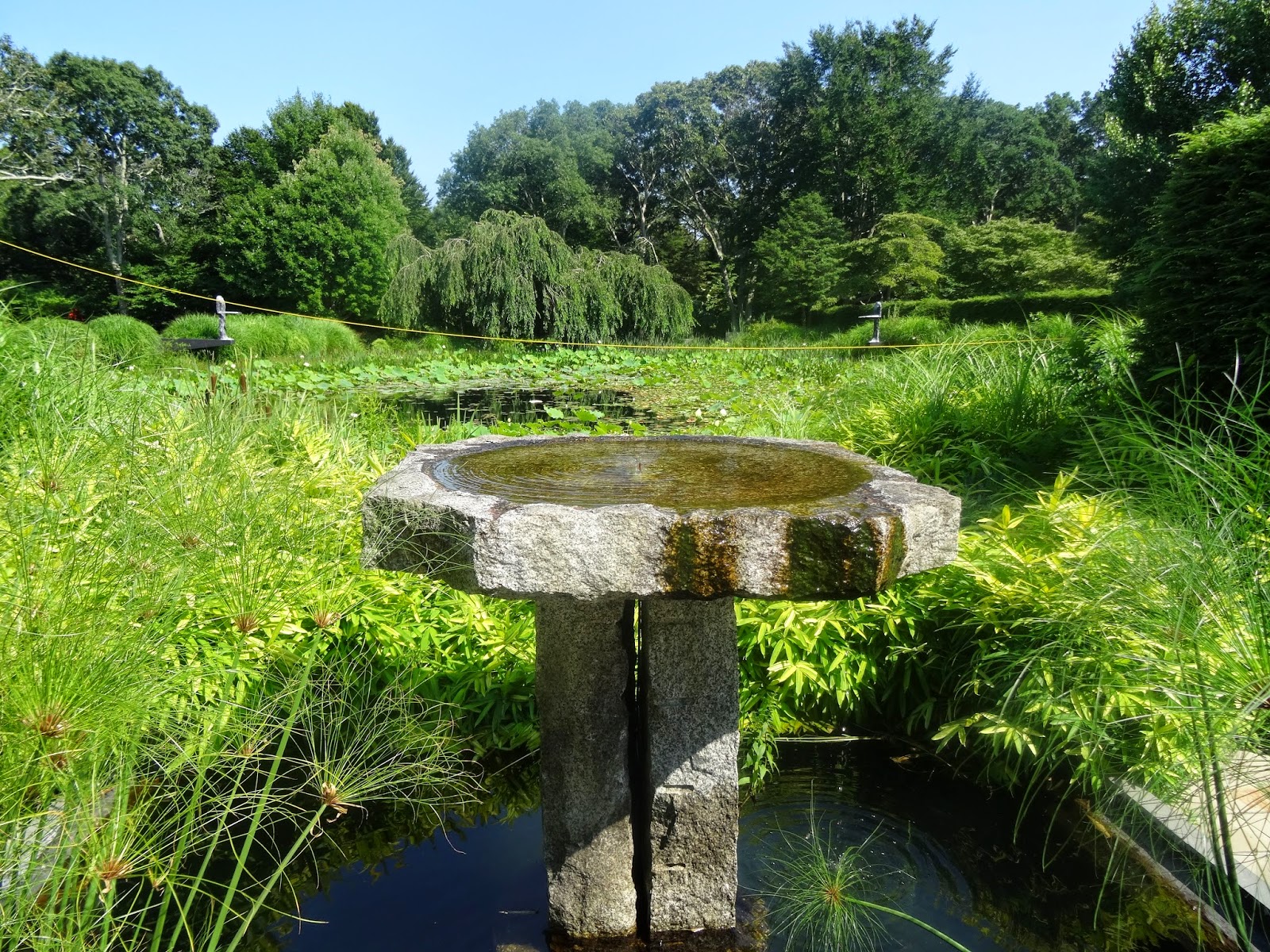
Peter's Pond (#16), Ground Level.
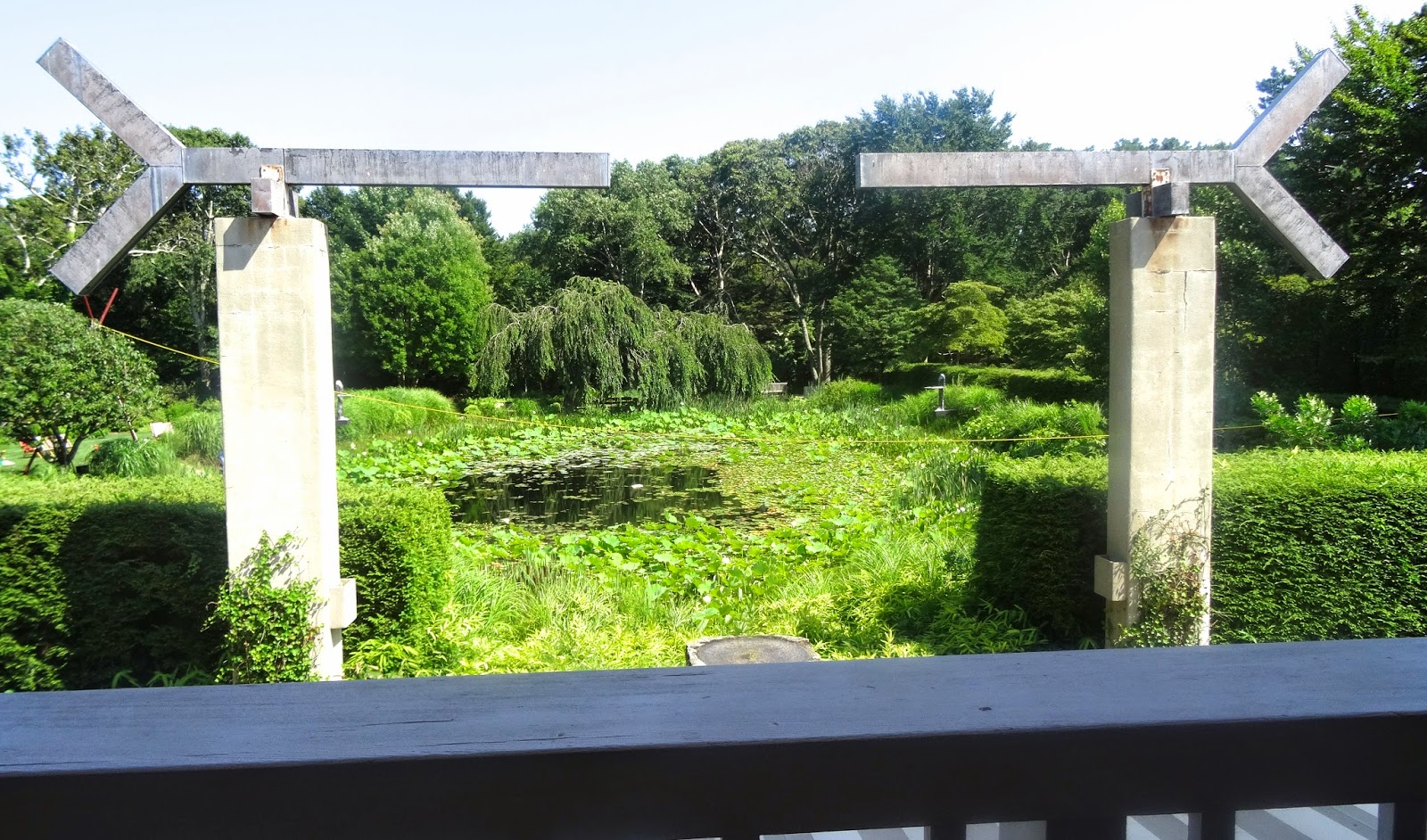
Peter's Pond (#16) can be thought of as the center of LongHouse. It dominates the view from the large terrace on the second floor of the main house, and also the view at the ground level, anchored by a large stone bird bath.

On the LongHouse map, Peter's Pond is shown in blue but in fact it is almost entirely covered by lily pads and other green plants. The view we had of the pond at ground level is shown at right.

Alice Tepper Marlin '66 looks at our
docent who appears giant-like
in the Red Garden (#17).
The Red Garden (#17) is so called because it has red flowers and red posts. The posts are carefully sized (height, circumference, interval distance) to give the illusion of greater depth. The posts that are farther away look as though they are farther away than they really are, so that as people walk toward them they appear to have been eating some kind of mushroom that makes them grow into giants.

The photo at left captures the effect, but it would be clearer with 3D or with multiple photos showing the change in size as a person walks toward the smaller posts.

Among the sculptures, the story behind Yoko Ono's colors-be-damned life-size Chess Set (#26) was particularly inspiring once the story behind it emerges like Brigadoon from the mist.

If you look at the photo, note there are no black pieces and no black squares on the chess board.

The Yoko Ono Chess Set (#26) is about half the size of a tennis court.
Why no black pieces? Why no black squares? Did the paint wear off??
At first it looks like a mistake or an unfinished installation. Or maybe the black paint has worn off in the 15 years since the sculpture was installed. The docent patiently waits for the penny to drop among the mystified tour members. The sculpture has more impact when the viewer has spent time puzzling over it.

It turns out that the lack of black lacquer on half of the pieces, the lack of black paint on half of the squares... is the point of the sculpture.

Yoko Ono is hammering home the point that war is about establishing identities and territories and then fighting over them.

As soon as we recognize that walk under many different colors - we have many IDs - we can deal with attempts to dehumanize other people based on a single ID that they share.

As soon as we understand that we can share our square, peace is possible.

Easier said than done, but... Imagine.

(Losing the colors, by the way, also happens to be an effective way of waging war by the defenders. If the defenders are out of sight or hard to identify, the attackers don't know what to do. That's what Edward II and Edward III found out when they tried to attack Robert the Bruce's Scotland. The outnumbered Scottish defenders under the "Good Sir James Douglas", as he is known on the Scottish side of the border, melted into the woods. They pursued what they called a "secret war". The musclebound American military machine has been subject to the same quandary in the face of a guerrilla or terrorist enemy that has a hidden identity. Where do we go to punish those responsible if we don't know who they are? Do we "round up the usual suspects"?)

Torii-like Sculpture in front of Peter's Pond (#16), viewed
from the terrace of the Pavilion (#34).
The group was privileged to be allowed inside the main house (#36). The house's architecture was inspired by the remarkably sustainable 7th Century Jingū (神宮) the Ise Jingū Grand Shrine in Ise, Japan, which I visited in 1986. The ancestral Shinto shrine, the equivalent in Japan to St. Peter's for Roman Catholics, is built to last 20 years.

It takes 20 years for a permanently employed family of artisans to build the shrine's replacement. Then the 20-year-old shrine is is torn down, and a new one is started with wood that comes from trees that were specially planted in the sacred imperial woods to mature at the time they are needed.

Features of a Torii.
We were not permitted to take photos of the interior of the Pavilion (#34), but I was allowed to take a photo of Peter's Pond from the large terrace. It shows the torii-like effect of the two sculptures at that end of the pond.

As one would expect of a famed collector of fabrics, the house has an unusual collection of interesting fabrics - and also ceramics, furniture and other objects.

The map of LongHouse sculptures and sites, available at the entrance (#3).
For those have not arranged a docent-guided tour in advance, LongHouse offers a Dial-In Docent. The OnCell guided tour is actually narrated by LongHouse Founder Jack Lenor Larsen. It can be accessed at any time by calling 631-604-7110.

The Dial-In Docent, available 24/7.
Call the number and instructions for use are provided. Stories about each of the sculptures and other features of LongHouse can be listened to via cell phone.

Each story is linked to the number posted at the site, in front of the  sculpture or other feature.

For those who are sufficiently expert in cell-phone technology, a bar code is provided at each site that can be read by the phone and will take you directly to the right point in the Dial-In Docent's repertoire.

There were countless different forms of seating, most of which could be utilized for a break in the walk. There is a rest room at the entrance (#3), to which one can return if necessary during one's visit.

Don't miss this gem of a place. It is rated by Trip Advisor as the #1 attraction in East Hampton - but then the Ocean is not included in the rating (Main Beach is, and ranks below LongHouse).

Postscript

I hope to be around for the 50th Reunion of the Wellesley Class of 1966 in mid-2016.

Here's a photo at right of the head of the parade at the last Wellesley Reunion I went to.

Note the two flamingoes near the center of the photo. There is a long story explaining why the flamingo is the class mascot.