 Your readership is appreciated. Please leave your comments or contact your blogger direct at teppermarlin @ aol.com. This blog's most-read posts in March 2020 were topped by the story of Tilly den Tex van Hall, wife of the great Resistance Banker Wally van Hall. They were: WW2 | Tilly den Tex van Hall (1907-1988) Jul 28, 2015 |
| WW2 | 1.The Boissevain Clan (Updated July 9, 2016)... Oct 31, 2014 |
| LISTER | First article on antiseptic surgery Mar 16, 2020 |
| U.S. FLAG | Why Its Origins Are Masked (Updated 20... Jun 2, 2013 |
| POETS | Elizabeth Bishop in Ouro Preto Feb 16, 2014 |
| GYM MEMBERSHIPS | Disclosures, Cancellations Feb 29, 2020, |
| MUSIC | The Trapp Family Camp (Personal Comments) Mar 19, 2014, |
| HERALDRY | Wilfred Bayne, OSB, Heraldist, Portsmou... Feb 20, 2016 |
| WOODIN | 9A. Musician (Updated Mar 11, 2017) Oct 13, 2013 |
| MUSIC | Gustav Mahler, Willem Mengelberg and Leona... Jan 23, 2016 |

TIME TRAVEL. Links to the past. Keys to understanding those who have come before.
Showing posts with label Ouro Preto. Show all posts
Showing posts with label Ouro Preto. Show all posts
Saturday, March 28, 2020
VIEWS | 210K, Ten Most-Read Posts in March


Wednesday, March 2, 2016
BLOG VIEWS | 60K, Top Posts

Thank you for reading.
Here are the most-read posts for the past month.
MOST-READ, PAST MONTH
| WOODIN | Appendix B. Descendants (Updated Feb. 16,... Mar 31, 2015, |
| WW2 | 5. Dutch Resistance Groups (Updated Feb. 7, ... Feb 17, 2015, |
| HERALDRY | Washington's Arms and the U.S. Flag (Up... Jun 2, 2013, |
| HERALDRY | Wilfred Bayne, OSB, Heraldist, Portsmou... Feb 20, 2016, |
| WOODIN | Ancestors and Descendants of Will Woodin,... Feb 17, 2016, |
| PECORA | Hearings and the Glass-Steagall Act, 1933... May 8, 2014, |
| WW2 | 4. Months 1-9–the de Booy Dilemmas Feb 27, 2015, |
| NYPD | Mollen Commission, Police Corruption Mar 20, 2012, |
| HITLER | March 5, 1933–Germany Elects Nazi Party Mar 5, 2015, |
| POETS | Elizabeth Bishop in Ouro Preto Feb 16, 2014, |
Thursday, June 19, 2014
POETS | Eliz Bishop in Petropolis (Place, Movie)
 |
| Petrópolis is named for the Emperor of Brazil, Dom Pedro I, who proclaimed Brazil independent from Portugal in September 1822, with little pushback. |
It is about American poet Elizabeth Bishop and Brazilian architect Carlota (Lota) de Macedo Soares, and their 16-year relationship, from 1951 to 1967.
Most of the time they lived in Petrópolis, north of Rio. They also spent much time together, as noted in an earlier post, at the Pouso do Chico Rei in Ouro Preto, farther north in Minas Gerais, on the Estrada Real (Royal Highway), created during Brazil's Gold Rush.
 |
| The bookcase at Petrópolis home, packed with books by Bishop et al. Note books by Carmen Oliveira and Robert Lowell. All photos by JT Marlin, 2014. |
- The movie's opening and closing shots are in New York. Bishop and Robert Lowell (a shy man who was attached to Quincy House at Harvard; I talked with him at some length while I was an undergraduate) sit on a bench facing a Central Park discussing her poem, and book, “One Art”.
- The movie's title refers to the tall lampposts Lota designed for the Parque do Flamengo. The moon lights up the opening stanzas of Bishop’s Rio de Janeiro poem “Going to the Bakery.”
- Bruno Barreto made the movie based on a 1995 bestselling- in-Brazil book, Carmen L. Oliveira’s Flores raras e banalíssimas: A história de Lota de Macedo Soares e Elizabeth Bishop, translated into English by Neil K. Besner (Rutgers, 2001).
 |
| A sample of the lush vegetation and water flow outside the writing studio. |
- Barreto’s mother, Lucy Barreto, is one of the producers - she bought the rights to the book, having long been a fan of Bishop’s poetry and having met the couple at a lunch in Fazenda Samambaia, in Petrópolis.
- Bruno Barreto was at first not interested in a movie, but changed his mind when he saw an opportunity to make a film that would have a more general message, about loss.
 |
| This is a view of Bishop's desk, where she wrote in Petrópolis. |
- The actress Miranda Otto portrays a shy but sensual Bishop, Glória Pires plays Lota as seductive. Bishop washes her hair while Lota soaks in the perfect white bathtub in the mountains at Petrópolis.
Comment:
Magdalena Edwards, in a review of the movie, says she tried to get inside Samambaia and couldn't. I can understand this. The main highway north to Minas Gerais is excellent for traveling. But leaving this highway to go up into the hills on steep winding roads can be bewildering.
Also, the owner of the estate used to be away often, winning prizes at dog shows. (There is a pet shop in New York City called Petrópolis that I suspect got its name from the network of kennels on the Samambaia property.)
 |
| Another view of the jungle-like exterior of the writing studio. |
Magdalena Edwards, in a review of the movie, says she tried to get inside Samambaia and couldn't. I can understand this. The main highway north to Minas Gerais is excellent for traveling. But leaving this highway to go up into the hills on steep winding roads can be bewildering.
Also, the owner of the estate used to be away often, winning prizes at dog shows. (There is a pet shop in New York City called Petrópolis that I suspect got its name from the network of kennels on the Samambaia property.)
It was a total coincidence that allowed my wife Alice and me to spend several hours at Samambaia, which unlike the other residences of Elizabeth Bishop is immaculately maintained. It was a privilege that we won't forget.
Sunday, February 16, 2014
POETS | Elizabeth Bishop in Ouro Preto
 |
| Time Traveler in front of Eliz Bishop's Ouro Preto home on her 103rd birthday, February 8, 2014. Photo by ATMarlin. |
- In 2012, I bemoaned the run-down state of her one-time home in Key West, which she purchased with Louise Crane.
- In 2013, I noted someone's concern that her former home in Ouro Preto, Brazil was also neglected.
- This year I find myself in Brazil and I have checked out the homes in which Bishop lived with her Brazilian lover.
 |
| 546 Mariana Road, leading from Ouro Preto. One of Bishop's homes in 1960-70. This photo, and any others not attributed, by JTMarlin. |
This Ouro Preto house is in a beautiful location. However, it is not being kept up and does not have the status either of a public monument or a well-cared-for private property.
It is owned by Linda Nemer, who is described by her friend Affonso Romano de Sant'Anna as a “lovely woman”.
However, she is nearly 83 and unfortunately not in good health. She is herself concerned about her ability to care for the house and ensure its future.
 |
| Plaque in Portuguese on Bishop's home in Ouro Preto. Photo by JTMarlin. |
Nemer asked the Ford Foundation about taking over Casa Mariana but nothing seems to have come of this request. Nemer met Bishop in 1969, through her brother, the painter José Alberto Nemer. José Alberto introduced the two of them and asked his sister to help Bishop, who was passing through an alcohol-related crisis.
For the next ten years, until Bishop's death in 1979, the Nemer family helped take care of Bishop. José Alberto was also an artistic adviser to Zuleika Borges Torrealba, who later purchased Bishop's home in Petropolis (and has kept it up beautifully, as I will show in a later post).
 |
| Looking up the road to Bishop's Ouro Preto home. |
I met Elizabeth in Rio in the 70s–she was going to give a course in creative writing at Harvard, and called me at the Hotel Gloria (or was it New World?). She gave me several books of American authors she had read and wanted to pass on to me.Carmen Lucia Oliveira wrote a book about Elizabeth Bishop's Brazil years with Lota de Macedo Soares. Her book was translated by Neil Besner, a Canadian who grew up in Brazil.
 |
| View of Bishop's home from the road. |
To find the Bishop house on the Mariana Road, one exits one side of the Museum of the Inconfidencia in the main square of Ouro Preto. It's a short walk and an even shorter drive.
 |
| Hotel Solar das Lajes. |
One place in Ouro Preto where Bishop used to hang out with de Macedo Soares is Pouso do Chico Rei, which used to be run by Bishop's friend Lilli Correia de Araujo, a widowed Danish innkeeper, who died six years ago.
The pousada is now being run by Lilli's grandson. Room #8, where Bishop stayed when her house was being renovated, is called the Elizabeth Bishop room. Visitors to the pousada who have posted on TripAdvisor praise its historical associations but some have concerns about maintenance.
 |
| Common room of Pouso do Chico Rei. Alice Tepper Marlin and Caroline Tepper-Marlin are checking it out. |
The Bishop house is closed. The pousada is open to the public, but it is a matter of luck for a visitor to find someone there to show one around.
 |
| In front of pousada. Photo by Alice Tepper Marlin. |
Most important, the future of both Bishop's house and the pousada are uncertain.
Is there an institution that could be a clearinghouse for those who are interested in the future of Elizabeth Bishop's residences? The Poetry Foundation?
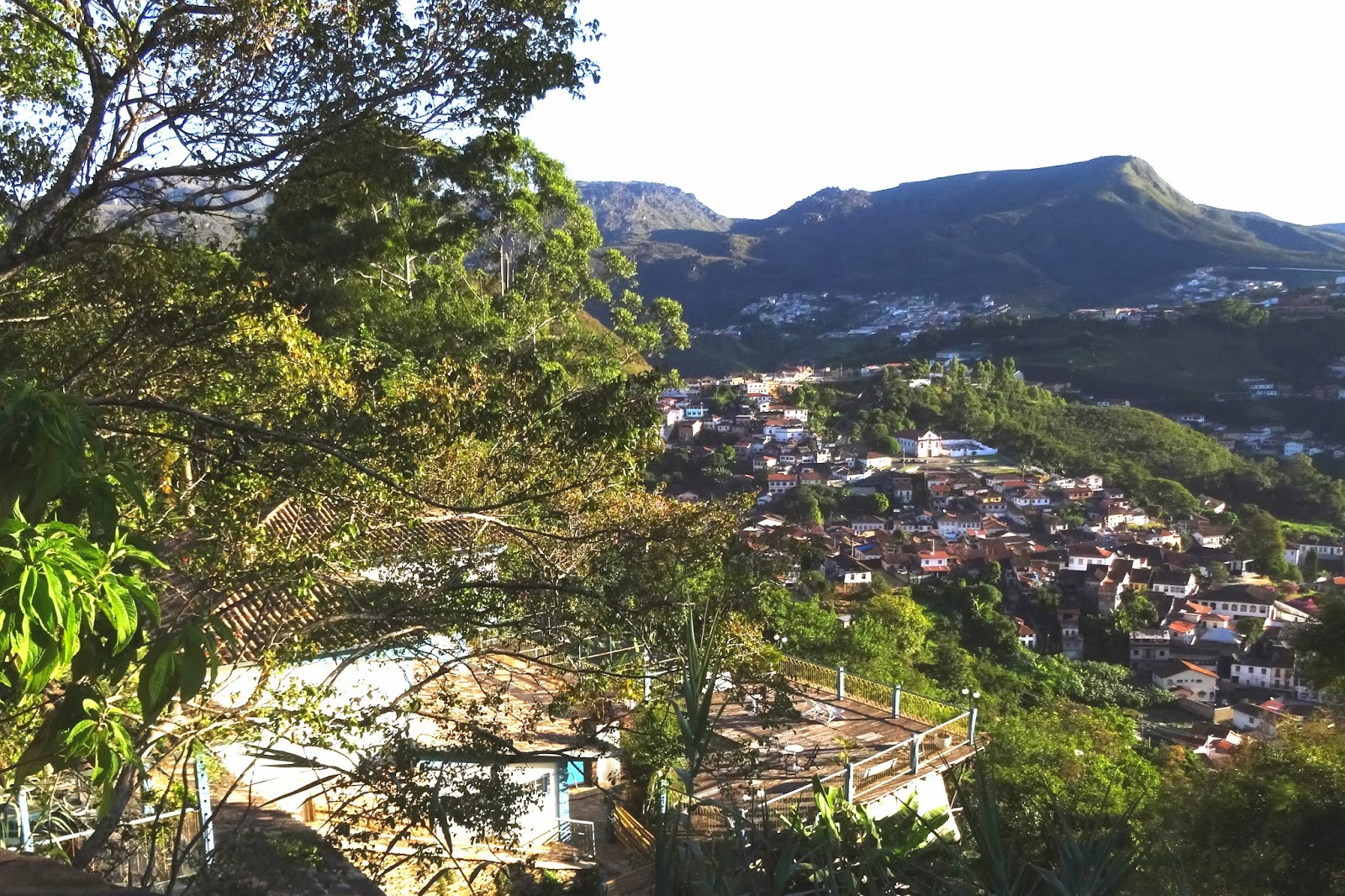 |
| View of the Ouro Preto valley from Mariana Road. |
https://www.newyorker.com/magazine/2017/03/06/elizabeth-bishops-art-of-losing
Subscribe to:
Posts (Atom)