The history of Votes for Women is a story of progress being achieved by American women - and men! - who did not accept that it was okay for women to be excluded from voting.
My toast is to the Delta Male, by which I mean men who have favored change on matters of gender discrimination, so that woman can vote and advance.
Even though men are the ones who have to make room in the balloting and on the ballot and in the labor market.
There may be no male members of the Delta Sigma Theta sorority. In that case, think of my toast as one to a mythical person.
Temperance Yes! Women No? Two Angry Women, London, 1840. The movement for woman suffrage started in 1840 when Elizabeth Cady Stanton and Lucretia Mott were told to shut up at the world-wide Temperance Convention in London.
The temperance and anti-slavery movements overlapped because many members of both groups were motivated by religious beliefs. Both Stanton and Mott were there because they believed God made men and women of all races equal. Yet they had to sit mutely in the balcony. They went home fuming. But... they had family responsibilities. So they put away their anger for years as they pursued their lives, Lucretia Mott as a young Quaker preacher in Philadelphia and Elizabeth Stanton as the mother of a brood of children in muddy Seneca Falls..
Women Organize, Seneca Falls, 1848. Mott came up to the Rochester area to speak at many of the regional Quaker meeting-houses. She and Stanton were still hopping mad about being treated as chattels at the London meeting. They met and Stanton organized a tea party on the occasion of Mott's visit. The tea party became a mini-pow-wow, and the group decided to hold a bigger meeting. The subject would be women's rights, and Stanton agreed to present a "Declaration of Sentiments". They called the event a Convention on the Rights of Women, they booked a church at Seneca Falls and they posted notices.
The poster was very explicit. Men were excluded on the first day. Men were invited to come on the second day, by which time it was thought that the women would have decided what rights to ask for.
Douglass Crashes Party, Makes Key Speech, 1848. Guess what? A well-known former slave, Frederick Douglass, gate-crashed the event on the first day. He decided if the meeting was about exclusion, well, that's something he had thought long and hard about. He knew about how to claim rights, as a black man and a former slave. He could be helpful to the white ladies.
He was indeed. The intervention Douglass contributed turned out to be pretty important for the future of the campaign for Votes for Women. At a crucial point in the proceedings, Elizabeth Cady Stanton and Lucretia Mott came to a fork in the road - and started heading down different tynes.
Should the convention go so far as to include the demand that women had the right to vote?
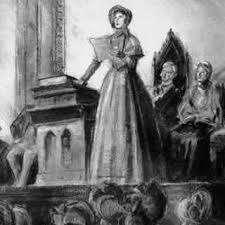 |
| Stanton demands the right to vote. Seneca Falls, 1848. |
Elizabeth Stanton announced that the time had come for women to demand the right to vote, despite the fact that her husband was deeply distressed at having a wife with such a radical thought.
Mott sided not with Elizabeth but with her husband. If Stanton were to proceed with the folly of placing a demand for the vote on the convention agenda, "Thee will make us ridiculous," she declared.
Opposed by her closest associates, that might have been the end of it. But then Douglass stepped up to the church lectern, unintimidated by the fact that he was an intruder.
Douglass said it was crucial that women demand the right to vote because no other rights are worth much without that. That's why black men made their demand for the right to vote their highest priority.
Douglass swayed the women. He made sense, and he spoke from deep knowledge and conviction. (In my play about Seneca Falls - performed in 1998 on the 150th anniversary - Rochester's Mayor Johnson played the part of Douglass and he delivered
his lines powerfully.)
"Votes for Women" Loses Out to Universal Male Suffrage, 1870. In 1866, the year after Lee surrendered to the Union, Lucy Stone and Susan B. Anthony created the American Equal Rights Association to promote universal suffrage. Expanding the vote was in the cards, and they wanted women included.
Douglass supported woman suffrage, yes, but not at the risk losing suffrage for black men. He feared that universal suffrage for men and women might fail. It would be too great an expansion of the vote. So he said to his woman suffrage friends - support black men getting the vote, and then I will again help you campaign for woman suffrage. No one at that time likely suspected it was going to take another 50 years for women to get the vote.
The "Irreconcilables" Wanted Universal White Suffrage. Lucy Stone and most other woman suffrage activists went along with Douglass's idea. But Stanton, Anthony and others fought back against Douglass. They opposed any expansion of the franchise if women were not in it. So in May 1869 they worked secretly with Julia Ward Howe to create the National Woman Suffrage Association (NWSA), opposing the proposed amendment giving the vote to black men. In the end, they lost the battle, as this Amendment was ratified in February 1870. But in a real sense their point of view prevailed in the southern states, which emasculated the power of black men's right to vote through the Jim Crow laws - voting restrictions such as a poll tax, or a literacy test, or a complex registration process, voting barriers that continued openly until the Voting Rights Act of 1963 and continue covertly even in 2013.
NWSA's opposition to the votes for black men angered not only black leaders like Douglass but the many abolitionists who saw the Civil War as primarily a battle against slavery and believed the victory of the North had to mean the imposition of votes for black men on the south. NWSA did not help its case by turning, in desperation, to the support of a man who would today be described as a white supremacist.
The attacks on the NWSA created internal disagreements. Susan B. Anthony wanted to focus only on suffrage, but Stanton and others had more general concerns such as the position of women in the churches, or laws pertaining to divorce. Other key NWSA members who took sides on these issues included May Wright Sewall (whose family name is on the Sewall-Belmont House and Museum), Clara Colby, Olympia Brown, Rachel Foster, Laura Johns and Harriet Shattuck.
AWSA Formed to Support Universal Suffrage. Unhappy with the racist sympathies of NWSA, Julia Ward Howe left it and rejoined Stone. In November 1869 they formed the American Woman Suffrage Association (AWSA), with help from Stone's husband Henry Browne Blackwell and Josephine Ruffin. AWSA supported votes for black men and worked on behalf of equal rights legislation at the state and local level. AWSA founders included Alice Stone Blackwell, Hannah Tracy Cutler, Margaret Campbell, William Dudley Foulke, Anna Howard Shaw and Mary Thomas.
Uneasy NAWSA Merger Deal. In October 1887, years after the Fifteenth Amendment became law, Stone proposed that AWSA and NWSA reunite. The feud between them was not healthy. Stone met with Anthony and others to discuss terms, starting with an agreement that the three principals, Stone, Stanton and Anthony, all exclude themselves from eligibility to serve as president. Anthony agreed. The two organization merged finally in May 1890 to form the National American Woman Suffrage Association (NAWSA). Besides the three principals, the leaders included Carrie Chapman Catt (who would many years later found the League of Women Voters), Frances Willard, Mary Church Terrell, Matilda Joslyn Gage and Anna Howard Shaw.
In February 1890 the National American Woman Suffrage Association held its first combined convention in Washington, D.C. Anthony campaigned for Stanton to be president and Stanton named Anthony as her vice president. Then, after her election and apparently by pre-arrangement, Stanton sailed for a two-year tour of England, leaving Anthony in charge after all.
Lucy Stone's supporters viewed the merger as founded on betrayal. The depth of their resentment was shown six years later. Stanton turned to de-genderizing the Woman's Bible and expected the book to be promoted by NAWSA when it was finished in 1896. Instead, Rachel Foster Avery led a narrow majority of NAWSA members in voting to exclude Stanton’s Bible from its scope of interest. Stanton died six years later and Susan B. Anthony soldiered for another four years after that, dying in 1906.
After the deaths of Stanton and Anthony, some of the poison went out of the NAWSA air and a new generation of suffragists come to the fore, starting in the women's colleges. Inez Milholland at Vassar became famous for occupying a cemetery in Poughkeepsie when the college's president James Monroe Taylor excluded the group from use of the chapel for a memorial for Susan B. Anthony. He threatened to expel any student who showed up for the graveyard ceremony. The president was defied by 40 students, accompanied by faculty members and members of the press.
Before the 1913 Parade, Organizers Considered Excluding Black Women. Inez Milholland, newly graduated from NYU Law School (where there is now an Inez Milholland professorship in her honor), had became a celebrity in New York City, riding her horse at the head of the huge Fifth Avenue parade in 1912. Years later, Mayor LaGuardia wrote to Milholland's mother, saying that Inez had converted him to Votes for Women at this parade.
 |
The March 3,1913 Suffragist Parade. It was a Monday, the day before President Wilson's first inauguration. Source: Reddit. |
NAWSA, which had moved to be nearer its philanthropic sources in New York City, decided it was time to become more aggressive, seeing as so many young women were joining the movement. Alva Belmont, a friend of Milholland, put up some money. NAWSA recruited Alice Paul from the Pankhurst suffragette team in London, to head up the moribund NAWSA Congressional Committee. Alice Paul decided what they needed was a parade in Washington like the one in New York, and she recruited Inez Milholland to ride a horse at the head of the parade.
During the weeks before the parade, the participation of black women in general was a thorny issue for Alice Paul. Later in life, she described this issue as her primary preoccupation during the days leading up to the parade.
In particular, a new breakaway sorority at Howard University, Delta Sigma Theta, wanted to participate. The leadership of the Alpha Kappa Alpha sorority at Howard University had decided to break away from what they viewed as the social pretensions of the Alphas and form a new sorority that would be less social and more activist in social causes.
These 22 Delta powerhouses wanted to march in the NAWSA parade. Alice Paul of course believed strongly in action, but she feared that participation by black women in still-segregated Washington would mean the southern chapters of NAWSA would reduce or end their participation in the parade and maybe even in NAWSA.
 |
On March 2, 2013, a National Park Service Ranger J. L. Dinkelater
tells the story of the picketing of the White House in 1917. The
National Woman's Party called on President Wilson to ask for his
support of the Anthony Amendment, two months after the death
of Inez Milholland Boissevain in November 1916. He ridiculed
their appeal and they started a nonstop picket. Photo by JT Marlin. |
When Alice Paul was put in charge of the "Congressional Committee" of NAWSA in 1912, she needed to move fast to get up to speed. Compared with the Pankhurst operation, she found the Committee was a shell. She began recruiting new people and raising money, much of it in New York City where NAWSA was based. While New Yorkers might not care whether black women were in the parade, a southern city like Washington was a different matter. Alice Paul saw a conflict between maximizing the Committee's support and allowing black women to march.
New Yorker Inez Milholland, whose father was the first Treasurer of the NAACP (and records suggest was the only white Protestant on the Board), was adamant that the new sorority should be allowed to march.
Inez threatened to withdraw her commitment to lead the Washington parade on horseback, and she had some clout because she had raised money for the Congressional Committee. Milholland, having led the 1912 parade in New York to great applause, was a media attraction from her days at Vassar, and was well connected with NAWSA supporters like Alva Belmont.
 |
Inez Milholland at the front
of the 1913 Washington parade.
The horse, Gray Dawn, was loaned
by Mr. A. D. Addison of DC.. |
Alice Paul was deeply torn, as she later recalls, and only grudgingly agreed to allow the Howard sorors to join the parade. Her plan, which appears not to have been shared with Inez Milholland, was to minimize the danger to the parade by putting all the black women at the end of the parade, after the (white) Men's League for Woman Suffrage marched.
To be fair to Alice Paul, it is hard in 2013 to get our heads around the doubly denied status of black women in 1913 Washington:
- Black men were supposedly enfranchised, even though the Jim Crow laws disenfranchised them as well as some less educated or poor whites.
- White women might not vote, but their spouses or male relatives did.
 |
Jane Barker, chair of the Turning Point Suffragist Memorial
Committee in 2011, before the newly restored iconic painting of Inez
Milholland, Sewall-Belmont House. Photo JT Marlin. |
The fear was that if black women marched in a parade they would remind southerners that adding women voters would also add black voters.
Contemporary accounts say that Alice Paul and the Congressional Committee leadership were worried that a visible black presence in the parade would set back progress toward a federal amendment.
Maybe they even foresaw that including black women in the parade would make it more likely that there would be a violent reaction among the men along the route. Suffragist Mary Church Terrell reported that the Delta Sigma Theta marchers were required to assemble in a segregated area. She also said that
If [Paul] and other white suffragist leaders could get the Anthony Amendment through without enfranchising African American women, they would do so.
Linda Lumsden's biography of Inez Milholland makes clear that however much Milholland may have gone along with excluding blacks in other contexts, she was firm about the participation of the Deltas. Milholland was, like her father, a member of the NAACP. Citing Mary Church Terrell again, Lumsden says that Milholland insisted that the Howard contingent be allowed to march in the college section. Emmett Scott, secretary-treasurer of Howard University, said that Milholland
was unwilling to participate in a parade symbolizing a movement which was not big enough or broad enough to live up to the principles for which it was contending. (See Inez, p. 91.)
On the day of the parade, Ida B. Wells-Barnett, a former slave who had become a leading suffragist, defied Alice Paul's ruling that black women march at the end of the parade, and she slipped into the march with her Chicago NAWSA delegation. Others followed suit. In the end, 22 women marched in the Delta contingent and an unknown number of black NAWSA delegates (100?) marched with their geographical groups. The only black organization to march as a group in the parade was the Howard delegation of Deltas. Even if, as is unlikely, as many as 150 black women in total were in the march, then using the
NY Times estimate for the number of marchers, these women were at most 3 percent of the total.
The march was the first major public demonstration in Washington. More important, there were 500,000 onlookers, mostly men, and they jeered the women as they went by. The parade devolved into a riot. Inez Milholland was on horseback at the front, and she pushed the edge of the crowd back with her horse. (There were supposed to be
four heralds at the front of the parade, but if the other three showed up, they are lost to newspaper coverage and therefore to history.) But as the parade continued on, push came to shove and the DC police couldn't keep order. Secretary of War Stimson ordered cavalry in from Fort Myer to calm things down, but by the time the military arrived
hundreds of women were injured.
The marchers were protected by the First Amendment, but not by the DC police. The DC police chief, Major Richard Sylvester, in a Senate investigation into the failure of the police to keep order, argued that he had
warned against the parade because racist "riff-raff" from the south would be in town to celebrate a Democrat's election as President. He was relieved of his job.
In the 2013 March, the Racial Balance Was Reversed. The March 3, 2013 march was a totally different affair. This time, the once-tiny sorority, Delta Sigma Theta, was the main organizer of the event. They have now grown into an army of 300,000 black women world-wide.
 |
| The Deltas listen to the leadership on "public service" and "social activism." |
For the 100th anniversary march, the Deltas reported an army of 20,000 young black women signed up to be in Washington. The National Park Service posted a crowd estimate of 20,000-25,000.
If 1,000 of the marchers were white men and women, then the racial percentages were exactly reversed. In 1913, at most 5 percent of the marchers were black. In 2013, at most 5 percent were white.
 |
Here we are, waiting to join the
parade. I am the sole passenger
at the window, with Model T
owner Ron Frenette. We are
waiting to join the parade. |
Another major difference is in the nature of the participation of the Deltas and the other women's groups in 2013. The white women's groups were naturally eager to commemorate and re-enact the actions of the suffragists to obtain the vote.
The original marchers were dressed in suffragist attire (purple, gold and white sashes and dresses), and so were the leaders of the traditional women's groups on March 3, 2013. Although a bit anachronistic (the picketing of the White House did not take place until 1917), the Turning Point Suffragist Memorial group had an effective tableau in place on March 2, 2013, showing the Silent Sentinels in front of the White House.
When the demonstrators were arrested by the DC Police in 1917, Inez Milholland's surviving sister Vida (Inez died in November 1916) was one of those taken away to the workhouse in Lorton, Va. At the time of the White House tableau, National Park Service Ranger J. L. Dinkelaker gave the history of woman suffrage in the United States while engaging the audience in some effective role playing (see photo above).
For the Deltas, the parade was much less about the history of Votes for Women than it was about moving on and tackling remaining injustices in the lives of American blacks and women. They marched with a purpose, dressed not in historical suffrage colors but in their sorority colors of red and white. The speeches in front of the Capitol (see photo above) were about moving on to new challenges, using their vote to attack continuing abuse of women in the home or in the workplace.
Here we are - Ron Frenette (driver) and I, ready to go, with a
sign in the window saying "VOTES FOR WOMEN - Men's
League for Woman Suffrage." In 1913 the parade had a large
men's contingent and a large number of motorized
vehicles.. In 2013 we in this Model T seem to have been it.
|
The traditional women's groups were by comparison scarce on the ground - several dozen each at most from any one group. The groups represented included the League of Women Voters (successor to NAWSA), the National Woman's Party/Sewall-Belmont House and Museum (successor to the breakaway Congressional Committee of NAWSA), the National Organization of Women, the Turning Point Suffragist Memorial Committee and the ERA of New Jersey.
Far from there being any rioting, it was an eerily quiet Sunday morning. The Deltas didn't rustle up any marching bands. Since Washington, DC workers now mostly live in suburban Maryland and Virginia, and churchgoers were in church, there were few onlookers, maybe 5,000 at most. Protest marches in Washington are now a regular occurrence. The Deltas were in D.C. in January and will be back next month.
The Reversal of Gender Balance. Back in 1913 there was a "Men's League for Woman Suffrage" with its own organization and officers. The Wikipedia entry dismisses it as being founded by "left-wing writers". Yes, Max Eastman was one of the founders, but chapters were formed in states around the country that had few left-wing writers. The active membership included Inez's father John E. Milholland, a newspaperman turned businessman who had editorialized on Votes for Women in the
New York Tribune. The "men's groups for woman suffrage" had their own place in the lineup of the 1913 Washington parade.
 |
End of the line. A black policeman, commanded by a female DC
police chief, tells us we need a permit to drive a car - any
car - in the parade, and in fact no permits were granted.
Back in 1913, many motor vehicles were in the parade,
plus numerous horses - and the white DC police
made little effort to control the unruly male crowds. |
In addition, most of the half-million people lining the streets in 2013 were men, who had come to ogle the young women. The young suffragettes from the women's colleges had given the Votes for Women movement some glamour that it lacked during the two last decades of the 19th century and Anthony and Stanton were maneuvering to stay in control until they died.
In 2013 there were a few spouses and male friends among the traditional suffragist groups, but I don't remember seeing a single male in the parade of the Deltas. The spectators were few, far between and unengaged. The single largest group of men were the Washington, DC police force, who were out in much larger numbers than in 2013.
Our Turning Point, 2013. It was fitting, as a measure of the extent to which the world has changed since 1913, that the sole male contingent of two was not allowed to participate in the parade. Our participation was organized by one of the traditional women's groups, which paired me (as great-nephew and super-fan of the "woman on the horse", Inez Milholland) with the owner of the Model T. We did our best to persuade the black police officer that we should be allowed in the parade, but he said there were no floats, no cars of any kind in the parade this year. Who knew? We could appeal to the police chief in Washington, but presumably she, Cathy Lanier, is on top of this situation and would have nothing to add.
So you can say about me and my companion
du jour Mr. Ron Frenette - who bore most of the burden of the day since he had to take the Model T out of mothballs - that we didn't qualify as Alpha Males that day. But maybe we qualify as something more important, men who celebrate change in the direction of greater equality and opportunity, even if the beneficiaries are a different gender, sexual preference, religion or race. (Even if the beneficiaries don't want or even discourage, for whatever reason, our gesture of support.)
I was brought up by an Alpha Grandmother and an Alpha Mother, and I have four Alpha Sisters. I'm married to an Alpha Wife and we have an Alpha Daughter. There are enough Alphas among the women in my family.
The Deltas by their charter probably exclude non-students or non-alumni, non-females and it would seem by a quick survey of the marchers, maybe even non-blacks, but if they don't mind I would be happy to be called a Delta Male.


