![]() |
| David Lefer |
Tuesday, January 19, 2021
INSURRECTION | The Constitution's Writers Feared Tyrants, including Mobs
Friday, October 30, 2020
BIRTHDAY | Robert Caro, 85
![]() |
| L to R: Alec Baldwin, Jules Feiffer, Robert Caro, East Hampton Library, 2015. Photo by JTMarlin. |
As an investigative reporter for Newsday, Robert Caro wrote why a proposed bridge across Long Island Sound from Rye to Oyster Bay would be a bad idea. It was promoted by Robert Moses, the urban planner. Caro had been convinced his articles would reverse the decision to build the bridge, but the state’s Assembly voted to begin construction. Caro was stunned. He said:
I got in the car and drove home to Long Island, and I kept thinking to myself: ‘Everything you’ve been doing is baloney. You’ve been writing under the belief that power in a democracy comes from the ballot box. But here’s a guy who has never been elected to anything, who has enough power to turn the entire state around, and you don’t have the slightest idea how he got it.
![]() |
| Caro's latest book, on his work habits. Previewed in The New Yorker. |
Caro keeps a strict routine when writing, like wearing a suit and a tie and keeping the same hours every day. He interviewed LBJ's speechwriter 22 times and lived in Texas for several years while doing research.Rhythm matters. Mood matters. Sense of place matters. All these things we talk about with novels, yet I feel that for history and biography to accomplish what they should accomplish, they have to pay as much attention to these devices as novels do.
Comment: I was introduced to Robert Caro in New York City in 1974 when The Power Broker first came out, I think by Julius C. C. Edelstein, who was a fellow professor when I taught in the CUNY system in the 1970s.
I have met the Caros several times since then at the Authors' Night in East Hampton, where they have a summer home. He has described both of his biographies as investigations into power—how it is acquired and how it is used. He has said: “The power of the historian is the power of the truth, a very basic thing.”
The Guardian published a fine interview with Caro last year that includes his wife Ina. She was Caro's sole research collaborator and recently wrote two books of her own on traveling in France. One of her books describes the palace that Fouquet built; it inspired Alice and me to visit it when we were in France recently.
Friday, September 18, 2020
THE FREE LIFE | 50 Years Ago
- Actress Pamela Brown, 28, daughter of Kentucky Congressman John Y. Brown Sr. and sister of Kentucky Fried Chicken CEO John Y. Brown, Jr.
- Her husband Rodney (Rod) Anderson, 32.
- Famed English balloonist Malcolm Brighton, 32.
- Only one of the three was an experienced balloonist.
- The balloonist was not involved in the design of the balloon, and had issues with it.
- Above all, the design did not allow easy separation of the gondola from the balloon.
- Another experienced balloonist pulled out because he decided it was too risky.
- On the day before the launch, a couple of tears were found in the balloon. One of them was described by farmer Miller as a "hole in the side" that was "patched".
- A crowd came to see them off. The press was out in force—a problem, because it meant rescheduling would have wasted their time and lost face for the crew.
- It was beautiful launch day. What could go wrong?
- The departure was fueled by champagne.
Genie Henderson was a close friend of fellow Kentuckian Pamela Brown. Here is her story: https://www.easthamptonstar.com/guestwords-opinion/2020917/guestwords-50-years-later-free-life. A plaque is being prepared to mark the pasture where the flight was launched.
Brighton's daughter, who was eight years old at the time, has initiated a special site to honor the quest represented by The Free Life—https://www.thefreelifeballoon.com/. It includes a compelling movie about the flight.
Thursday, September 17, 2020
CONSTITUTION DAY | 233rd Anniversary Celebration
September 17, 2020. On this day in 1787 the United States Constitution was signed by delegates at the final meeting of the Constitutional Convention.
The Signing of the United States Constitution by Louis S. Glanzman, 1987.
Commissioned by State Societies of the Daughters of the American
Revolution. Independence National Historical Park Collection.
We may forget that the Constitutional Convention was created to raise money for the central government so it could maintain a military to stop piracy. The central government was supposed to provide such services but it didn't have the money to pay for them. It didn't have an effective means of collecting its debts.
The war with Britain had officially ended four years before, but the Articles of Confederation created by the Second Continental Congress were weak. After overthrowing an imperious monarch, George III, the Americans had no taste for another strong central authority. The United States had no real executive, just a president of the Congress. The Second Continental Congress had thrown the government-creating job back to each of the 13 colonies. They did their job, and took on what they could, but some things could only be done centrally, like maintaining an Army and a Navy.
By 1787, not one of the states was up-to-date on its federal taxes. The central government had no way to force collection. Meanwhile, pirates were attacking American ships, and the central government could afford neither to pay them off nor defend the ships. Troops were deserting, and the national military was unable to come to the aid of states when they needed it.
James Madison and other leaders organized the Constitutional Convention to enable the central government to collect taxes and provide reliable services. In May 1787, delegates arrived in Philadelphia and there spent the next four months rewriting the Articles of Confederation. It was hot and buggy. The 55 highly educated, and by-now politically seasoned, delegates averaged 42 years of age:
- George Washington was elected president and rarely spoke.
- Alexander Hamilton was absent from much of the deliberations but emerged as the principal author of the Federalist Papers, arguing why the Constitution should be ratified.
- Governor Morris was a witty man with a peg leg who wrote the famous preamble to the Constitution.
- Benjamin Franklin, 81, could no longer walk and had to be carried around Philadelphia in a sedan chair.
- James Madison was constantly in attendance, taking notes and arguing strenuously for a more powerful central government. A small man, 5'6" and weighing 120 pounds, he became known as "the Father of the Constitution.” On the final day of the Constitutional Convention, he wrote: "“Franklin, looking towards the President's Chair, at the back of which a rising sun happened to be painted, observed to a few members near him, that painters had found it difficult to distinguish in their art a rising from a setting sun. I have, said he, often … looked at that behind the President without being able to tell whether it was rising or setting: But now at length I have the happiness to know that it is a rising and not a setting Sun.”
Today, the National Archives is celebrating the 233rd anniversary of the signing of the Constitution with special virtual programs for all ages, including book talks, public programs, and interactive webinars. The National Archives is the permanent home of the original Constitution. See the Archives special Celebrating Constitution Day page for information about its public programs, family activities, and online resources.
Sunday, September 13, 2020
SHIPS | MS Boissevain (1937-1968)
September 13, 2020—The MS [Motor Ship, sometimes MV for Motor Vessel] Boissevain was officially launched on June 3, 1937 in Hamburg. The passenger ship was impressive for its day. It and the other two ships built at the same time were intended for luxury service in Asia, Africa and Latin America.
| Launching party arrives, met by shipyard executives. |
| Ellegonda Duranda Boissevain (born 1914) is in front at right. She later married Eduard Veltman and subsequently Arthur Anton Kunzil. |
| Unidentified white-haired man presides. |
| Dignitaries depart. |
![]() |
| Speed trials for the MS Boissevain were a success. |
Tuesday, August 11, 2020
WW2 | Who Mostly Enforced the Blackouts?
August 12, 2020—Wearing a mask in Covid-19 time is akin to blacking out your windows, or turning off lights, during World War 2.
Who enforced the rules then? The answer is they were volunteer air raid wardens. They would patrol the streets looking for lights in windows, and they would knock on the doors of people who were letting light appear that could guide enemy bombers.
Was there much violation of the rules? No, because everyone understood it was in the interest of the neighborhood not to be visible from the air at night.
More here.
Sunday, August 2, 2020
WW2 HOLLAND | Jimmy Huizinga, Wally van Hall
![]() |
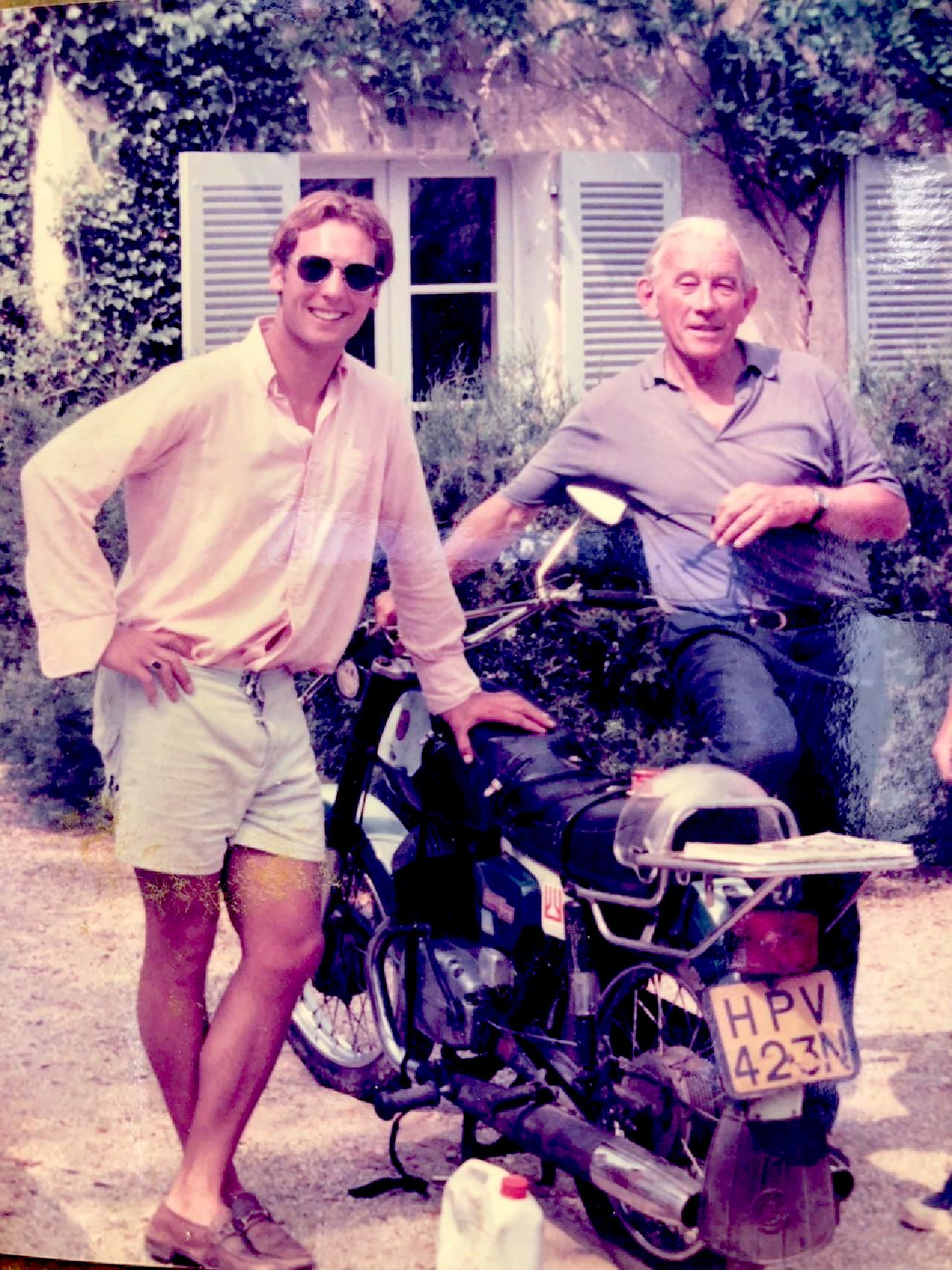
| Rider McDowell (L) and Jimmy Huizinga, in Gassin, France. |
I was introduced to them in London through a girlfriend’s family. The Huizingas were looking for “an artist in residence” to work as a part time handyman on their property in Gassin [just west of Saint-Tropez on the Côte d'Azur], for the spring and summer season. Jimmy had just turned 70 and Mary used to say she was born on the same day as JFK.
I was an aspiring writer and Jimmy read and critiqued my first mystery novel as well as my first play and several short stories. They were great fun and we became very close and would get together for years afterwards in London for dinner, etc.
The first time I met Jimmy we walked from his property in Gassin to one being constructed by industrialist Gunter Sachs, an enormous ornate plate glass, bird cage of a house. And Jimmy said, “Look at this monstrosity and look at all that glass. Are you thinking what I’m thinking?” And I said, “I think so.” And with a chuckle we each picked up a rock, and threw it at this enormous window, and then ran.
Even though Jimmy was 50 years older than me, we were like pals. We'd drive around to various expatriate parties around St Tropez. Jimmy knew everyone. My English girlfriend would hang with Jimmy's wife, and Jimmy and I would raise hell at the parties, meeting people and having constant laughs.
Once we went skiing for the day, some French Alp. We drove all the way there and back in one day. When we returned, he made me drag him into his house, feigning two broken legs to Mary, who almost fainted.