 |
Japan, 1986 - Precious companions: Caroline and
(over the shoulder) the Osborne 3 in backpack. |
The death of Andrew Kay three days ago got me thinking about my Osborne 3 computer, which I just retrieved from storage.
Like
Kay with the Kaypro, Adam Osborne was an inventor who might have been a big winner in the personal computer sweepstakes.
Osborne Computing was, following its introduction of the Osborne 1 computer in April 1981, the most rapidly growing company in Silicon Valley. The Osborne 1 weighed 24 pounds and didn't have a battery, but for people who then assumed that computers were too big to carry, it was a break-through.
It was also one of the first computers to come with a good word-processing program and communications software, which were my main uses, and was much cheaper than the competition at under $1,800.
 |
Japan, 1986 - on an excursion
with my Osborne 3. |
The
official history of IBM cites the August 1981 debut of the IBM PC and compares it with the needs of the IBM 360 and other mainframes. It cites the earliest mainframes as costing $9 million, requiring an air-conditioned quarter-acre of space and 60 people to run and keep it loaded with instructions, and goes on:
The IBM PC changed all that. It was a very small machine that could not only process information faster than those ponderous mainframes of the 1960s but also hook up to the home TV set, process text and store more words than a huge cookbook - all for a price tag of less than $1,600.
Actually, the Osborne 1 "changed all that" a few months before. But Osborne Computing is not around to argue with IBM's story.
Five years after the introduction of the Osborne 1, I got a good deal on the Osborne 3, which was much improved and looked a lot like the MacBook Pro I am typing on now except for a major difference - the LCD screen on the Osborne 3 is smaller and much harder to read.
 |
With the Osborne 3 today. It turned
on after recharging. My serial number
is 1-00134 - looks like it was #134 in
production. |
The Osborne 3 LCD screen displays only 16 lines - actually, adequate for word-processing and email, which were my main uses. The lower 9 lines of the 25-line MS-DOS screen are made visible by toggling. When it was conceived, the Osborne 3 had a 25-line LCD screen, but the size was reduced to save production costs and the bottom part of the screen was covered over.
Armed with the Osborne 3, I went on a summer-long trip to Japan in 1986 with my wife Alice and two children, who were then 9 and 12 years old.
 |
The Osborne 3, side view with the
15-volt DC transformer and battery
charger. I have two. The first one
didn't work. The second one did. |
The computer served me well, but Osborne Computing went out of business that year. What happened?
Back in 1981, the Osborne 1 computer was the world's first portable computer. It had a great future. In 2011, on the 30th anniversary of the introduction of the first Osborne, Harry McCracken at
Technologizer wrote an article that explains what went wrong. There were some technical bad calls, but the company-killing mistake that Adam Osborne made has now been given a name, the "Osborne Effect."
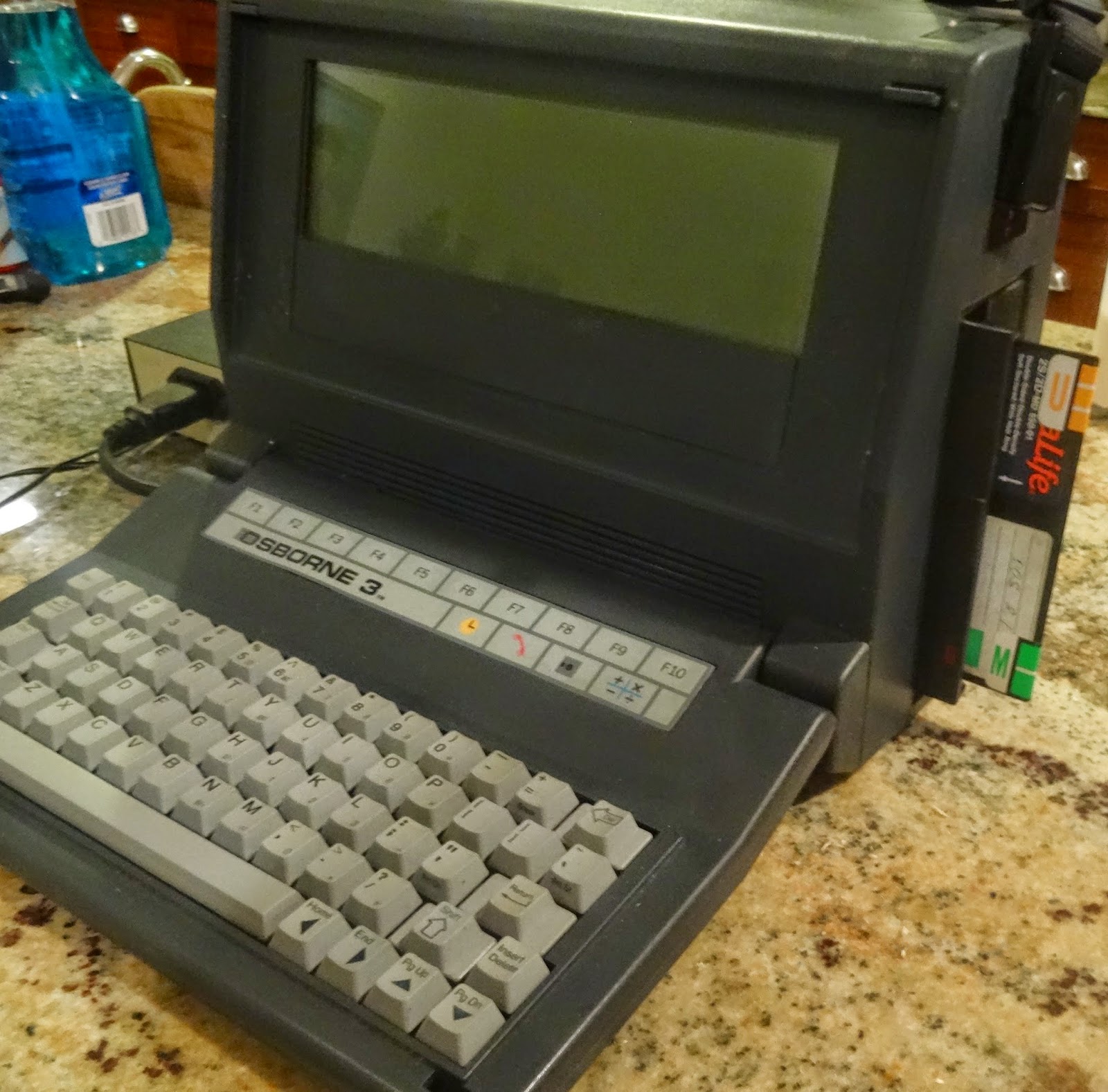 |
View from the disk-drive side. The
Osbornes had two disk drives. The
front drive had the disk with what
we would call today the "app", in
this case the MS-DOS 2.1 software. |
The "Osborne Effect" was the consequence of Adam Osborne's announcing a new product, the Osborne 2, before it was ready to sell. That made the company's existing product obsolete. That stopped sales of the existing product, starving the company of the money it needed to get the Osborne 2 finished and into production. The rollout took longer than the sales-challenged company could last. In the language of the dot-com boom, the burn rate overtook the fume date and the Osborne disappeared into think air. To paraphrase Genesis 3:19, "Smoke thou art and to smoke shalt thou return."
This killing of sales of the existing Osborne 1 by promising an Osborne 2 that isn't ready to sell is a classic business mistake. It is the second way, after being the first to bring out a portable computer, that Osborne's name has become immortal. IBM did something like this with its main-frame business (the IBM 360 and the PC were both delayed) but IBM was so big it careened on. Osborne, however, had pumped-up competitors who ate its lunch and then its dinner.
 |
Adam Osborne. Photo
by Stephen Osborne. |
Adam Osborne failed most on the marketing end. He was a poor spokesman for his own product. His parents were British and Polish-American, and he was born in Thailand, but he spent most of his childhood in India, where his parents were devotees of transcendental meditation.
Maybe it was his parents' spiritual journey that taught him to see things clearly and put a premium on honesty. That's what made him a consumer's friend when he wrote his curmudgeonly computer column, "From the Fountainhead", before he started his company.
 |
| The four icons on the Osborne 3. |
However, I speculate that his track record having been based on picking apart every new computer product may have made the transition to promoter-in-chief a difficult one.
Instead of selling his product by focusing on the Incredible Good News of computer portability, he was honest about explaining where own computer fell short. He famously told
InfoWorld that his product was slow and "merely adequate" relative to his competition, which was at first mainly the Kaypro.
 |
This miner's head lamp is what I used in
1986 to read the Osborne 3 LCD screen. |
The Osborne's LCD screen, for example, was not very readable. I took care of that with a miner's head flashlight, strapped around my head. By shifting my head one way or another I could read the screen anywhere except in the sun.
 |
The Book of World
City Rankings, 1986 |
In fact the Osborne 3 that I owned was a great machine. It stills works, 30 years later.
I would bring it to the library of the International House in Tokyo and worked on it at a table there. During the summer of 1986 I wrote about a trip to revisit the Tokyo Metropolitan Government, which had been very helpful on an earlier visit in 1981 that produced data for
The Book of World City Rankings.
I remember writing articles using the Osborne 3 that summer, about visiting the shrine at Ise, about the usefulness of backpacks and a need to invent one with more style and brand it, the Recruit campaign-stock scandal, and a proposal for a monument to Commodore Perry at Shimoda.
 |
This is what the boot-up screen of my Osborne 3 looks
like. The initial screen shows the month of October 1984. |
A forum at a
museum of old computers fills in the history of the Osborne 3. It was developed by Vadem Inc., of Santa Clara, California, which offered the design to Osborne Computer Corp for production.
The Osborne 3
and prior versions (Encore and Amstread) were based on MS-DOS with a built-in modem and a world clock on the boot-up screen. The keyboard has four "icon" keys which called up small programs located in ROM - the "phone" key called up the communication software, the "clock" key called a calendar, the "disk" key booted the system and the "calculator" key called a small electronic calculator.
Vadem's engineers made the Osborne 3, issued in 1985, much more compatible with IBM. The Osborne 3 that I carried around Japan in 1986 was the last Osborne computer sold in USA. Osborne Corp. was operating under bankruptcy conditions starting in 1983 and finally shut down in 1986.


 1. One takes about an hour to make, plus the time to buy a dynamo for it.


