Pages

Sunday, December 22, 2013

COLLEGE GRADES | Inflation Since 1960!

December 22, 2013 – An A is not what an A used to be, it seems.

College grades have apparently inflated since my college days.

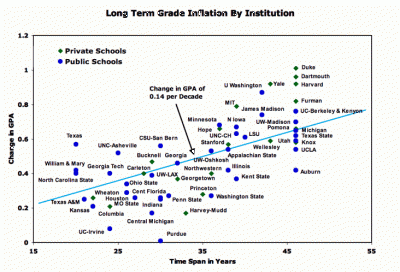
An A is now the most common college grade, according to an article published last year by Professors Stuart Rojstaczer and Christopher Healy:

In 1960, 15 percent of all college grades were A's.  The most common grade was a C.
In 2012, an A was the most common grade given nationally (43 percent). A's and B's together now account for 73 percent of all college grades at public universities and 86 percent of all private school grades. 
Arthur Levine, president of the Woodrow Wilson National Fellowship Foundation and former president of Columbia's Teachers College, similarly found:
  • In 1969, seven percent of students reported an A- grade-point-average or higher.  
  • By 2009, that number had risen to 41 percent. 
Even at Harvard? The Harvard Crimson earlier this month says yes. In "Substantiating Fears of Grade Inflation, Dean Says Median Grade at Harvard College Is A-," it reports that at Harvard, the "most common grade is A." The story has 504 comments as of today.

Rojstaczer and Healy say that student engagement has fallen and the average amount of study has declined from 24 hours a week in the '60s to 15 hours a week today.

Some universities including Columbia and Dartmouth, have begun issuing "honest transcripts", disclosing not only the letter grade the student received for each class, but also the average grade that the professor gave the entire class, thereby putting each grade in context. Thomas Lindsay reports this month (mindingthecampus.com) that a bill in Texas would require honest transcripts for students at Texas universities. .

Comments:

The "honest transcript" program has been championed by Republicans, presumably because they don't like liberal elites, even though the careers of both Bushes were assisted by these elites. Also, teachers are highly unionized and focusing on grade inflation can be seen as a way for those who criticize labor unions to demonstrate a collective laziness among students and faculty.

However, I don't know why this should be a partisan issue. As it stands, recent graduates from colleges with inflated grades can virtually all present themselves as above average among their college peers. However, honest transcripts are not a panacea:
1. Some classes are selective. The professor interviews you and decides who can take the course. In this situation, the presumption is that all the students deserve higher grades than in a less selective introductory class.
2. Some universities are more selective than others. A Harvard student is presumed to be better prepared than a second- or third-tier college. Should Harvard students be graded the same way as an unselective college?
3. Some departments are more likely to grade on a curve than others. Science and engineering, where knowledge is more easily measured, tend to grade more strictly.
4. In professional schools – business, law, medicine – grade inflation is less of a problem because professors know that the grades are directly related to a person's career and the task of sorting out the best students is taken very seriously. Being too generous to students could mean certifying people as capable of something that they are not. leading  to poor clinical performance.
What other considerations should be on the table?

Saturday, December 21, 2013

Emily MacDonnell Boissevain - Irish Rose among the Tulips


I have been going back, fascinated all over again, reviewing my notes on the life of my mother's mother's mother, Emily MacDonnell Boissevain. Her life reveals much of the culture and concerns of her times, especially relations between the Netherlands and Ireland, and the Netherlands and Indonesia.

Emily was an Irish woman who married a Dutchman and lived her life in Holland. Her letters provide a unique cross-cultural window on Britain, Ireland, the Netherlands and Indonesia, with a few interesting sidelights on the United States.  The letters especially show how much of Ireland she brought with her to Holland.

Like Trojan Aeneas settling in the area that became Rome, Emily brought with her the household gods of Protestant Dublin. She was proud of her Irishness and spoke English to her 11 children during her long years as the wife of Dutch newspaper editor Charles Boissevain, although she learned enough to write a few letters in Dutch.  After the death of Charles she lived alone with the family governess, Polly, meeting separately with visitors based on Emily’s higher status.  Yet she bonded like a Viking conqueror with the country in which she settled.  Emily never traveled alone, and only visited where she had relatives.

Emily’s Father: Hercules MacDonnell

Emily’s parents were Judge Hercules Henry Graves MacDonnell and Emily Ann Moylan; we have letters from Judge Hercules MacDonnell to his granddaughter Olga.  Emily’s family on her father’s side can be traced back to Somerled, the first Lord of the Isles in the 12th century (see genealogy).  Her grandfather Rev. Richard MacDonnell was Provost of Trinity College, Dublin, and was a solid Provost during an uneventful period, according to the history of the college.
                                               
Judge Hercules MacDonnell had an even better-known brother, Sir Richard, who became  Britain’s Governor-General (or equivalent) of five British colonies -- Gambia, St. Vincent and Lucia, Nova Scotia, South Australia and Hong Kong.  Following that he was knighted and retired to the south of France.  His wife was called Blanche.  Any map of South Australia will show the MacDonnell range of mountains at the northern extremity, near Alice Springs, named after Sir Richard.  Some ports and rivers are also named after him and his wife Blanche. A desert plant is also named after him. In Hong Kong, Sir Richard was oine of the first to build a house high above the city.[1]   

The MacDonnell family can be traced back to Alastair Carrach, grandson of the 1st Lord of the Isles in Scotland, who founded the Keppoch branch of the great Clan Donald.  In 1431, part of Keppoch lands were forfeited and given to the MacIntoshes, causing a feud between the MacIntoshes and the MacDonnells of Keppoch.  The MacDonnells were warriors and the 9th chief of the clan, who was exiled for most of his life, served in the Swedish army.  The 12th chief of the clan was murdered along with his brother in 1663.  Coll, the 15th chief of the clan, was noted for his fierceness and was called “Coll of the Cows;” he resisted by the power of the sword MacIntosh attempts to retake his lands.   His son Alexander, the 16th chief, died fighting for the Jacobites at the Battle of Culloden.  At some point the MacDonnells emigrated to Ireland where they became part of the Protestant (Presbyterian or Church of Ireland) ruling gentry. 

The motto of the MacDonnell family was “toujours prêt” (always ready).  In Dutch, a word pronounced like “prêt” means “fun” and this meaning of the word is more descriptive of the flavor of the atmosphere in the home that Emily MacDonnell made with Charles Boissevain.  “Fun” is a good description of the goal of Olga Boissevain, their third daughter, according to her daughter [interview, 1996].  Another MacDonnell family motto was “per mare, per terra”, which has a military association because it was adopted as a motto by the U.S. Marines.

Emily’s Mother: Emily Ann Moylan

Hercules MacDonnell was a lawyer (a barrister, arguing in court) when he married Emily Ann Moylan, who was referred to in the press at the time as the niece of Lady Jodrell.  Since his religious father did not approve of the marriage to Miss Moylan (either because she was too young or was not Church of Ireland; the stories do not say), the two eloped to London via Liverpool, whence they traveled via “horseless carriage” on the just-completed railway line connecting the two cities.  They were said to be the first couple in history ever to use the horseless carriage as a vehicle for elopement. 

Coincidentally, Lady Jodrell’s daughter eloped at virtually the same time, because her parents considered her too young to marry, so that the Moylan-Jodrell cousins’ elopements were covered by the press at the same time, as in the clip shown on the previous page.

Emily Héloїse MacDonnell


Emily Héloїse MacDonnell was born in Dublin in June 1, 1844. She grew up in a Dublin suburb and Sligo Bay, the daughter of Judge Hercules Graves MacDonnell and Emily Ann Moylan.

Emily met Charles when he was a young journalist visiting Dublin to cover an international exposition.  Charles Boissevain was two years older than Emily, having been born in Amsterdam on October 28, 1842. While in Dublin, he became ill. A sponsor of the exposition, Dublin attorney Hercules MacDonnell, invited Charles to recuperate in his home.  His daughter Emily tended to Charles and they fell in love.  Charles returned to Holland with his fiancée, and Emily married Charles Boissevain in Southampton [Woolston?] on June 27, 1867. [Stamboek van der Boissevains, entry for Charles Boissevain, p. 143.]

For the rest of her life, Emily’s main contact with Ireland seems to have been from visiting her Jameson and Crichton and Phibbs relatives at Sligo Bay in the northwest of Ireland.  She died at Het Houten Huis near Drafna in Blaricum on January 26, 1931, surviving Charles by about four years and the British-born family governess Polly by about two years.

Robert Boissevain [who left his wife and six children in Holland and emigrated to America to the voiced disapproval of all but his mother] said to his sister Hilda: “ I never feared opening a letter from my mother.  Never were there reproaches in it.” [Interview, 1996.]


[1] Randal Marlin researched Sir Richard’s life in Dublin in the 1990s. An Australian desert flower is named after Sir Richard. 

Saturday, November 16, 2013

November 16 - Day that "In Search of Lost Time" Was First Self-Published

Madeleines de Commercy
Today in 1913, 100 years ago, the first volume of a novel by Marcel Proust (1871-1922), "A la recherche du temps perdu" ("In Search of Lost Time", aka, before 1992, "Remembrance of Things Past"), was published.

Proust began it in 1909, after eating a piece of a madeleine dipped in tea. He uses this experience as a central theme of his book, describing the involuntary remembrances he had of eating madeleines with his aunt in his childhood. (Julia Childs's recipe for them is here.)

Proust's book was turned down by several publishers. Garrison Keillor says that the editor of a prestigious French literary magazine advised Proust that it not be published because of syntactical errors, and he quotes another editor as responding to Proust:
My dear fellow, I may be dead from the neck up, but rack my brains as I may I can't see why a chap should need 30 pages to describe how he turns over in bed before going to sleep.
Proust put up his own money to self-publish the book, paying Grasset to print it. He worked on the subsequent six volumes the rest of his life, 1.5 million words, until he succumbed to a fatal illness. His brother published the final volumes based on manuscripts Marcel left behind.

Edmund White says that the book is "the most respected novel of the 20th century."

Justice Stephen Breyer
Associate Supreme Court Justice Stephen Breyer has an interesting interview in the latest (November 7) New York Review of Books. It is an English translation of an interview in La Revue des Deux Mondes that he had with a French journalist.

Breyer says he used Proust to learn French when he was a legal intern in Paris for an American law firm, and the Recherche was the first book he read in French.  He describes Proust as "the Shakespeare of the inner mind".

The interviewer asks Breyer why he likes Proust so much. Here is his answer:
It’s all there in Proust—all mankind! Not only all the different character types, but also every emotion, every imaginable situation. Proust is a universal author: he can touch anyone, for different reasons; each of us can find some piece of himself in Proust, at different ages. For instance, the narrator of the Recherche is obsessed with the Duchesse de Guermantes. To him, Oriane embodies a slice of the history of France and glows like a stained-glass window, wreathed in the aura of her aristocratic lineage. Now, however different the situations may be, we have all of us—in our childhood, our adolescence, or later in life—admired from afar someone who has dazzled us for this reason or that. And when we read Proust, we get a glimpse of ourselves.
For more comments by Justice Breyer, click on this link.

Saturday, November 9, 2013

November 9 - Kristallnacht, the Public Start of Hitler's Holocaust

The morning after Kristallnacht... Hitler's murderous
Holocaust was now without fear and in full view.
Today is the 75th anniversary of Kristallnacht (Crystal-night, "the night of broken glass"). In 1938 the Nazis coordinated an attack throughout Germany on Jewish homes, businesses, and synagogues - as Garrison Keillor has reminded us in The Writer's Almanac.

My brother Randal Marlin has just issued a second edition of his book on Propaganda, and I was interested to see how the Kristallnacht attacks as outlined by Keillor follow the Propaganda playbook.

1. The attacks were inspired by the murder of a German diplomat by a Jew in Paris. When Hitler heard the news, he decided to use the event to stage a mass uprising in response. (Playbook: Milk events for propaganda purposes.)

2. He and Joseph Goebbels contacted storm troopers throughout Germany and told them to attack Jewish buildings, making the attacks look like spontaneous demonstrations. (Playbook: Stir up public resentment, or fake it.)

3. The police were told not to interfere with the demonstrators, but instead to arrest the Jewish victims! (Playbook: Accuse the victims.)

4. Similarly, firefighters were told only to put out fires in any adjacent non-Jewish properties. (Playbook: Do not protect the victims.)

Everyone cooperated. In all, more than 1,000 synagogues were burned or destroyed. Rioters looted 7,500 Jewish businesses and vandalized Jewish hospitals, homes, schools, and cemeteries. Many of the attackers were neighbors of the victims.

To pile injury on injury:

1. The Nazis confiscated any compensation claims that insurance companies paid to the Jews who lost their property.

2. They imposed a huge collective fine on the Jewish community for the crime of having incited the violence by the murder of the diplomat.

3. They barred Jews from schools and most public places, and forced them to adhere to new curfews.

4. In the days following, thousands of Jews were sent to concentration camps. Kristallnacht was the opening shot of the Holocaust. Before that night, the Nazis killed people secretly. Afterwards, the Nazis persecuted and killed Jews openly, because the propaganda ensured that public opinion would be against anyone who tried to stop them. I contacted my brother for his views on Kristallnacht. He said:
What a terrifying time it must have been to be Jew at that time, recognizing that you had no protection from lawless violence. What needs attention is the original statement of Nazi party principles. They made it quite clear that Jews were not citizens of Germany and were without civic standing regarding voting and other civic rights that we today take for granted. That was back in the early 1920s. The moral for us today is to wake up and see what is happening with respect to erosion of the principle of rule of law, and not to allow it to decay any further.
To document what my brother says about the Nazi party origins, I found a timeline used in schools for teaching about the Holocaust. It shows that the Nazi principles were developed in 1923-25.
  • In 1923, the Nazis attempted to take over Munich and failed. In a 24-day trial, Hitler gained the sympathy of the judges and some of the public, and his fellow Nazis were given a light sentence. At this point, the Nazis were a small group on trial, and no one feared them. In prison, Hitler wrote Mein Kampf, which laid out the Nazi principles of German pride, and enmity to Jews and Bolsheviks in Germany and worldwide.
  • In 1925, Hitler's book was published after he emerged from prison and started reconstituting the Nazi party under his sole leadership.
  • In 1928, Hitler's party got 2.6 percent of the vote. 
  • In 1929, the worldwide crash occurred, followed by the Great Depression. This threw the German government into confusion and provided an opportunity for Hitler to exploit public distress. 
  • In 1930 Hitler's support leaped to 18 percent of the vote.
  • In 1932, Hitler got 37 percent. 
  • In 1933, President Paul von Hindenburg -- reelected the previous year, but aging and at his wit's end -- appointed Hitler as Chancellor. The Nazis moved in, establishing a police state, step by step. Albert Einstein was in USA, decided not to return to Germany after his German residences were ransacked. 
  • In March 1938, Hitler annexed Austria without bloodshed. 
  • In October 1938, having threatened Neville Chamberlain's Britain with war, the Western powers looked away as Germany marched into the Sudetenland and carved up Czechoslovakia.
  • In November, convinced by now that Western governments were paper tigers, Hitler initiated the Holocaust with Kristallnacht.

Sunday, October 20, 2013

HALLOWEEN | NYC Timetable and Empire State Bldg. Light Show

Empire State Building today.
This ain't white (compare with
moon). Photo by JTMarlin.
A web site supposedly tells you what color the Empire State Building is every day. But today (Sunday, October 20)... it lies!

This evening it was supposed to be white according to the website, but the photo from where I live shows it to be purple. Check my color perception via the photo at left.

I say this as a pre-Halloween warning. The Empire State Realty Trust (ESRT), which owns the ES Building, assures us that they and Clear Channel Media and Entertainment will together honor Halloween by synchronizing the ES Building's million LED tower lights to Halloween-themed music.

The music will allegedly be broadcast on Clear Channel’s radio stations Z100 and 103.5 KTU at 8:30 p.m. EST, on Halloween, i.e., Thursday, October 31, 2013. A light show is promised, designed by Marc Brickman, to a Halloween-inspired soundtrack. Now let's see if it all happens as promised.

The CEO of ESRT, Anthony E. Malkin, says this is the first-ever Halloween LED tower light show. So glitches could occur.

The light and music show will also be featured during the 40th anniversary of New York’s Greenwich Village Halloween Parade (website here):
  • Parade (in costume) forms on 6th Avenue from Spring Street to 16th Street  from 7:00pm to 10:30pm.
  • It will be covered on WPIX Channel 11 from 7:30pm to 9:00pm.
  • It will be on NY 1 from 8:00pm to 9:30pm.
Following the live performance, anyone can watch the video of the entire light show on the ES Building’s YouTube page. Individuals are invited to take part in the showcase by utilizing the hashtag #ESBoo on twitter etc.

Saturday, October 19, 2013

GW | Oct. 19–Cornwallis Surrenders at Yorktown

Admiral de Grasse defeats the British
Navy in early September. General 
Washington opts to march 400 miles
to defeat Lord Cornwallis.
Today is the anniversary of the surrender that ended the American Revolutionary War. Since this year it is also the weekend after the (we hope not temporary) end of the Tea Party shutdown of the U.S. government, maybe a comparison of the two capitulations is in order.

The shutdown has not been as hard as it was on George Washington and his troops, whose clothing was tattered and food and other supplies were depleted. But the shutdown has affected more people. Washington learned that the British army under Lord Cornwallis were building a naval base on the Yorktown Peninsula in Virginia. He decided impulsively to march his army from NY to Virginia to try to trap the Brits. He feinted toward NY to tie down the Brits there, then undertook the bold–and very risky–400-mile march to Washington.

The mid-October siege of Yorktown 
lasts just a few days.
The equivalent for President Obama was taking the step of announcing he would not (unlike President Clinton vis-a-vis Speaker Gingrich in 1995-96) negotiate with the Tea Party, given their doomsday tactics. What negotiation occurred took place among women Senators of both parties.

Both of the two risky gambles paid off. Even though Lord Cornwallis had advance word of Washington's march, he stayed put because he assumed he had time to wait to be evacuated by the British navy. He seems not to have known that British navy had been dispersed by a French fleet from the south under Admiral de Grasse and would not be coming to anyone's rescue while the French were in the York River.

So Washington, and an allied French army under General Rochambeau (a debt to the French that we would should remember when France-bashers get going), surrounded Yorktown and bombarded the city with siege cannons brought by the French.
Washington accepts surrender of Brits.

After several days of this with no naval relief, Cornwallis sent word he would surrender. Washington told the British to march out and give up their arms, and the surrender began at 2 am today in 1781, five years after the Declaration of Independence. Cornwallis sent his sword to General Rochambeau, signalling that the British had been defeated by the French, not the Americans.

But for whatever reason, England didn't have the money or stomach for another army, and they appealed to the United States for peace. The Treaty of Paris was signed two years later, and the Revolutionary War was won.

Thursday, October 17, 2013

October 17 - Einstein Moved to the USA

Einstein, 1921
In 1933 on this day, Albert Einstein officially moved to the USA to teach at Princeton University.

A German-Swiss physicist and Nobel laureate, Einstein is best known for his special and general theories of relativity and for his bold hypothesis concerning the particle nature of light. He is widely viewed as the most famous scientist of the 20th century. He was born in Ulm, Württemberg, in March 1879.

As a youth in Munich, he showed an intense curiosity about nature and an ability to understand difficult mathematical concepts. In high school, he excelled in mathematics but failed utterly in the classics. At 16 Einstein moved away from his family to Switzerland, where his good performance in mathematics barely got him into a technical college in Zurich. He did not enjoy it and skipped most lectures, preferring to play his violin or to study physics in the library. He graduated in 1900 but his professors did not recommend him for a place in university. Instead, he secured a junior position in the patent office at Bern. In the year 1905 he published four papers, for which the year is named the "annus mirabilis":
1. The first paper, published June 9, dealt with the photoelectric effect and the nature of light; applying Planck's quantum theory, which had been proposed five years earlier and was quietly forgotten. The paper, "On a Heuristic Viewpoint Concerning the Production and Transformation of Light", proposed the idea of energy quantaThis paper won him the Nobel Prize in physics 16 years later.
2. The second article, published July 18, "On the Motion of Small Particles Suspended in a Stationary Liquid, as Required by the Molecular Kinetic Theory of Heat", offered a stochastic model of Brownian motion.
3. His third paper, published September 26, was “On the Electrodynamics of Moving Bodies” and had the most profound effect on modern physics. It contained Einstein's Special Theory of Relativity. Einstein proposed that it was meaningless to speak of one body moving and another body being still. Bodies can only be thought of as moving in relationship to each other. All motion is relative to some frame of reference, and the laws of nature apply unchanged, whatever that frame of reference. In particular, this means that the speed of electromagnetic radiation (such as light) is always the same, no matter the frame of reference. In subsequent years, results predicted on the basis of his theory were confirmed over and over again, and the Special Theory of Relativity eventually revolutionized how scientists viewed matter, space, time and all the things that interact with them. 
4.On November 21, 1905, Annalen der Physik published a fourth paper, ("Does the Inertia of a Body Depend Upon Its Energy Content?"), in which Einstein developed an argument for arguably the most famous equation in the field of physics: E = mc2. 
In 1909 Einstein was given a chair in theoretical physics in Switzerland, but he returned to Germany five years later to take up a specially created post as director of the Kaiser Wilhelm Physical Institute in Berlin, where he developed his General Theory of Relativity, recognizing that mass and energy are two sides of the same coin, leading to the famous formula E=mc2. The new theory made bold predictions about the interaction of light and gravity that had not yet been observed and which were at variance with Newtonian physics.

After the war ended, in 1919, scientists used a total eclipse of the sun to confirm that light from distant stars was indeed deflected as it passed through the influence of the sun's gravity, exactly as General Relativity predicted. Einstein became internationally renowned.

When Hitler took over as chancellor in 1933, he had been in California working as a visiting professor. Einstein's apartment in Berlin and his summer cottage in the country were raided, his papers confiscated, and his bank accounts closed.

Einstein was smart enough to get the message right away that he was unwelcome. He returned to Europe and handed in his German passport. He considered many offers, from places like Paris, Istanbul and Oxford, eventually deciding on Princeton, which offered him an attractive package teaching at its Institute for Advanced Study.

He had hesitations about Princeton. It had a secret quota system allowing only a small percentage of the incoming class to be Jewish. The Institute's director, Abraham Flexner, was worried that Einstein would be too directly involved in Jewish refugee causes, so he micromanaged Einstein's public appearances, trying to keep him out of the public eye. He even declined an invitation for Einstein to see FDR at the White House without telling the scientist. When Einstein found out, he personally called Eleanor Roosevelt and arranged for a visit anyway, and then complained about the incident in a letter to a rabbi friend of his, giving the return address as "Concentration Camp, Princeton."

In 1938, incoming freshmen at Princeton ranked Einstein as the second-greatest living person. First place went to Adolf Hitler.

(Thanks to Garrison Keillor and the Writer's Almanac, from which this is mostly adapted.)